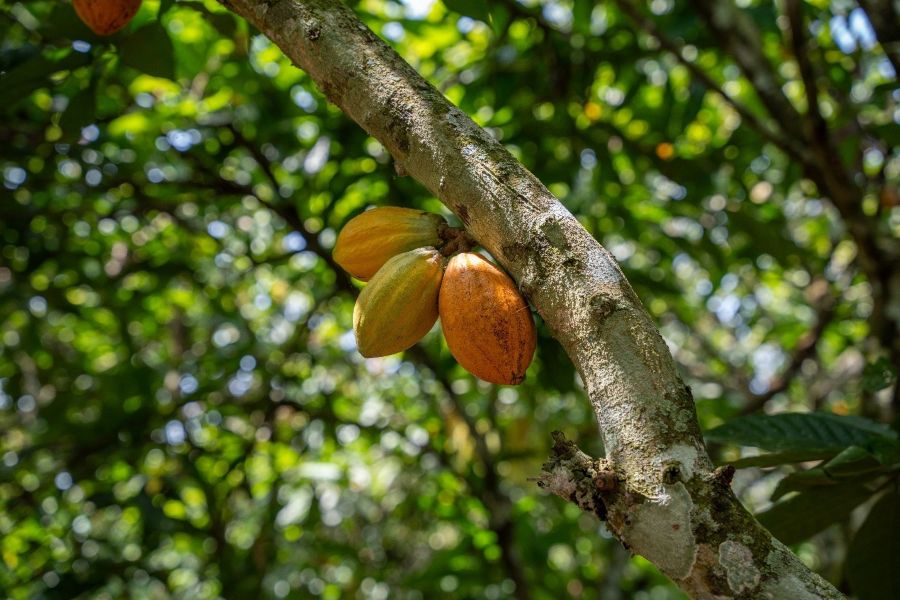
©FAO/Maryia Kukharava - Agroforestry cocoa farm in Côte d’Ivoire, where reforestation and forest protection are boosting harvests and bringing sustainable economic benefits to local communities.
Deforestation and forest degradation are among the most pressing crises of our time. Each year, millions of hectares of forest are lost, undermining global efforts to combat climate change, protect biodiversity, and ensure food security. At the same time, forests remain essential for the well-being of billions of people worldwide, especially rural communities whose livelihoods depend on them. If we are to turn the tide, incremental or linear solutions are no longer enough to solve the complexity of the issue – we need systemic shifts in the way our agrifood systems function.
The urgency to act cannot be overstated. Global commitments on climate change, biodiversity, and sustainable development all hinge on our ability to halt deforestation. Forests regulate rainfall, store carbon, and sustain biodiversity at a scale no other system can replicate. They also stabilize food production by preventing soil erosion, providing pollination, and moderating microclimates.
Yet agriculture, the sector most dependent on healthy forests, is also one of the drivers of their loss. Without sustainable management of the land, expanding cropland for soy, palm oil, and cocoa, clearing forests for cattle ranching, or excessive and unsustainable harvesting fuelwood erodes the very foundation of long-term food security. What we face is not simply an environmental issue, but a structural imbalance between how societies might value short-term economic gain and how they account for long-term ecological stability.
The good news is that many solutions already exist, and countries are proving that in enhanced agriculture practices and strengthening capacities of small scale farmers lay key solutions that can drive balanced prosperity. Farmers around the world are practicing agroforestry, communities are managing their forests sustainably, and countries are piloting policies that balance protection with production. The problem is not the lack of ideas, but the lack of coherence, alignment with underlying drivers, and scale. This is why focusing on systemic shifts is so critical: they allow us to connect the dots and address the root causes, not just the symptoms, of deforestation. If we are to succeed, at least six major systemic shifts deserve our attention:
- Strengthen land governance by addressing policy incoherence, insecure tenure, and corruption, ensuring that Indigenous Peoples and local communities are fully engaged in decision-making.
- Scale sustainable agricultural production models, including through agroecology, agroforestry, silvopastoral systems and restoration of degraded lands to relieve pressure on forests while boosting yields and livelihoods.
- Promote responsible consumption and trade, ensuring transparency and accountability in supply chains and align trade and consumer side policies with sustainability objectives.
- Create incentives to maintain forest integrity with financial and fiscal mechanisms, payments for ecosystem services, blended finance, or repurposed subsidies, that make forests more valuable standing than cleared.
- Enhance information systems so they are reliable, transparent, and accessible, empowering governments, businesses, and communities with the data needed for better informed decision making.
- Improve rural livelihoods and promote equity and inclusion, tackling poverty, gender inequality, and lack of opportunities that often leave forest-dependent communities with little choice but to clear land.
These shifts are intertwined and progress in one area reinforces progress in others. To capture and connect these dynamics in a practical way, FAO and partners have developed the Solutions-tree: Solutions to halting deforestation – through sustainable agrifood systems transformation. Developed through collaboration of experts across sectors and skills sets, with governments, and partners like Japan’s Ministry of Agriculture, Forestry and Fisheries and the UN-REDD Programme, it provides a structured tool to rethink how we design strategies, policies, and projects to halt deforestation. The tool organizes solutions under the six systemic shifts, helping decision-makers identify, compare, and adapt measures that directly address the underlying drivers in a given context. It also highlights interlinkages, how better governance underpins sustainable production, how information systems support trade transparency, and how incentives connect to improved livelihoods, and provides tools and case studies to enable them.
FAO, including through UN-REDD, Green Climate Fund projects and in collaboration with key partners is currently piloting the Solutions-tree prototype in several countries and will be able to present it at the end of this year. With the forthcoming launch, we invite all partners and countries to join the effort, by sharing contributions, case studies and relevant publications. By expanding the knowledge base together, we can refine, scale, and accelerate this important global action.
Pilot results and integrated solutions have been shared and promoted at major global and regional events. In Japan, at the Ninth Tokyo International Conference on African Development (TICAD 9) Demonstrating the impact of cross-sectoral collaboration and co-creating knowledge for halting deforestation and forest degradation in Africa side event, the importance of linking agriculture and forestry to accelerate sustainable development in Africa was emphasized. Countries showcased innovative partnerships across sectors, including through REDD+, their leadership in boosting catalytic transformation of land use and commodities on the ground, their central role in co-developing knowledge to decouple growth from deforestation contributing to achieve climate targets and shared prosperity. Benin highlighted the use of Solutions-tree in developing their REDD+ strategy has helped the country to move from a fragmented vision to a systemic approach. More recently in Bangkok, ten governments across Asia-Pacific, 20+ partner organizations, and embassy representatives shared progress and challenges in scaling solutions, from better data, smallholder support and policy and governance enhancements, to trust and collaboration as key to enable transformative change.
Together, these milestones underline the growing role of the Solutions-tree that expanding into not just a framework, but a collaborative platform that grows stronger with each contribution, helping us move toward a new equilibrium, one that ensures food security, protects biodiversity, and sustains livelihoods for generations to come.