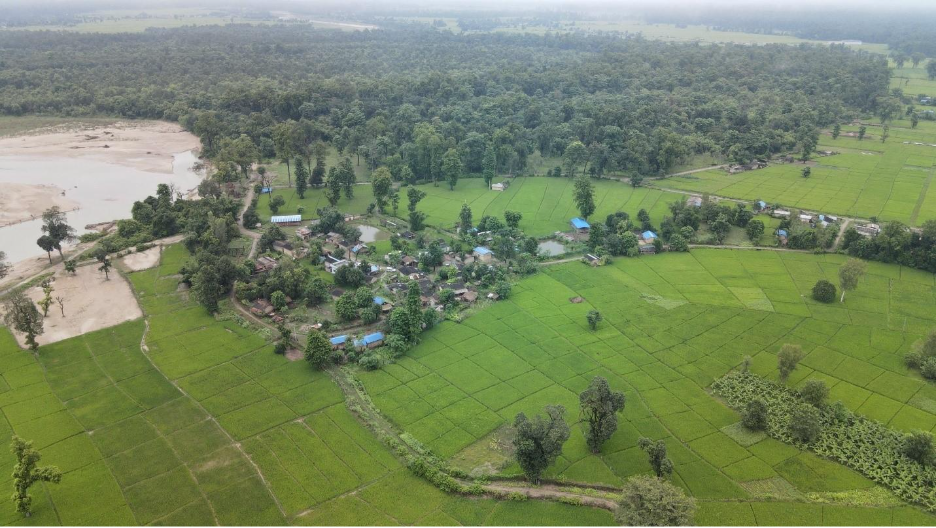
A view of Kailali community Forest in the Kailali district of Nepal.
With the LEAF carbon purchase agreement, Nepal’s decade-long forest restoration journey enters a new phase where restoration meets markets.
On 23 January 2026, the Government of Nepal signed a landmark Emission Reductions Purchase Agreement (ERPA) with the LEAF Coalition for the sale of up to four million tonnes of verified emission reductions from its jurisdictional REDD+ programme across Gandaki, Bagmati, and Lumbini provinces, with an estimated value of up to US$55 million.
The agreement makes Nepal the first forest country in Asia to conclude a LEAF purchase agreement and the first globally to offer correspondingly adjusted credits to LEAF private-sector buyers, enabling potential use under compliance mechanisms such as Singapore’s carbon tax and CORSIA, while representing one of the largest prospective inflows of performance-based forest finance in Nepal’s history and connecting decades of community forestry restoration to international carbon markets for the first time.
LEAF is one of the world’s largest public–private coalitions for high-integrity forest carbon, offering countries a guaranteed floor price of US$10 per tonne for jurisdictional high-integrity REDD+ credits. This pricing assurance has been a major incentive for forest nations to advance high-integrity REDD+ programs at scale.
The agreement marks Nepal’s formal entry into high-integrity carbon markets under the Architecture for REDD+ Transactions (ART) and its TREES standard.
The revenue, when accessed, will be allocated under Nepal’s emerging benefit-sharing framework, which has a provision to channel 80 per cent to community forest user groups, Indigenous Peoples, local governments, and other implementing entities.
This marks an important milestone for Nepal, reflecting the culmination of decades of important work to protect forests, establish credible monitoring systems, and place communities at the center of forest stewardship. UN-REDD is pleased to have partnered with Nepal to support this work over many years. This progress creates more opportunities to bring a greater share of Nepal’s forests under jurisdictional approaches and positions the country to engage markets that reward integrity, scale, and long-term performance.
Mario Boccucci | Head of the UN-REDD Secretariat.
ART-TREES requires countries to meet rigorous criteria on carbon accounting, forest monitoring, social and environmental safeguards, Indigenous rights, permanence, leakage control, and benefit-sharing. Nepal spent the past several years aligning its systems with these requirements, including updating its National REDD+ Strategy, strengthening safeguards, and creating a three-tier institutional mechanism for REDD+ implementation.
Long before forest conservation became global shorthand for climate action, Nepal recognized the social and ecological risks of losing forest cover. By the early 1990s, Nepal’s forests were in steep decline, with cover down to about 29 per cent and communities lacking authority to manage nearby lands. The government responded by transferring stewardship to local user groups—a shift captured in the slogan “Green forests are Nepal’s treasure.” The Forest Act 2049 B.S. and Community Forestry Guideline 2052 B.S. formalized this model, empowering communities to plan, enforce rules, and benefit from restored forests.
When the forest became ours, people changed how they looked at it.
From those early handovers grew one of the world’s largest and most influential community-based conservation initiatives. Today, more than 22,000 user groups manage approximately 2.4 million hectares, involving over 3 million households—roughly one in four Nepalis.
Just as transformative as the ecological gains were the social ones. Community forestry became a powerful engine for equity. New rules mandated that at least 50 per cent of committee members be women, and that two of the four top positions—chair, vice-chair, secretary, treasurer—must be held by women. The effect was profound. “The same women who carried grass bundles now carry meeting files,” Chapagain says. Over 73,000 women leaders have emerged through the system, many stepping into elected roles in local, provincial, and federal government. The affirmative-action blueprint pioneered in community forestry later inspired the 33 percent women’s representation provision in Nepal’s 2015 Constitution.
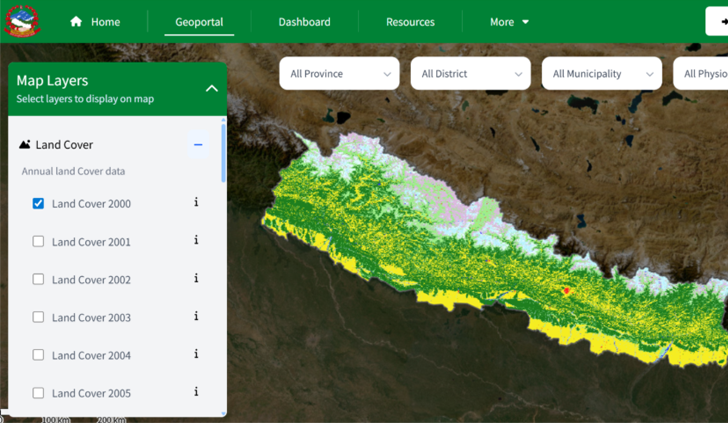
Today, Nepal’s forest cover stands near 46 percent. The recovery is visible from space—and from the ground, where the shade has returned.
 |
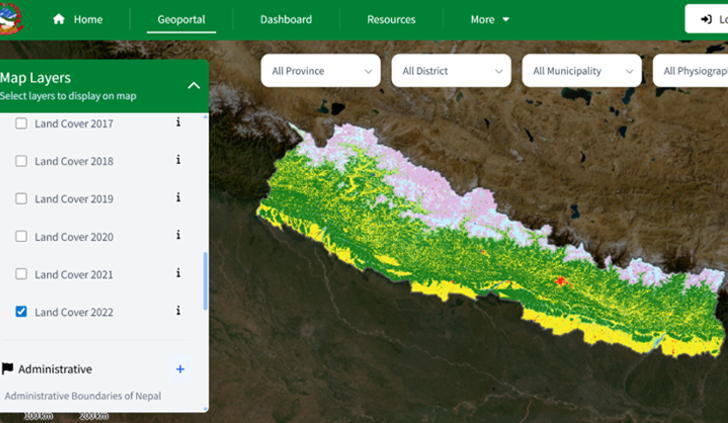 |
Image: Land cover of Nepal 2000 and 2022 from FRTC MRV porta, showing increased forest cover
Shared Stewardship
Nepal’s forest revival emerged from a convergence of national resolve and external support. Development partners recognized that devolving forest authority was not only sound ecology but good governance. Switzerland, Norway, the UK, Denmark—and later Finland and Australia—has through these years supported nurseries, training centres, governance reforms, and literacy programs that turned subsistence users into resource stewards.
This represents an important milestone in Nepal’s long-standing efforts to protect forests and addressing climate change, and demonstrates Nepal’s commitment and readiness to deliver verified emission reductions, which can unlock significant payments from public and private buyers to support Nepal in building a sustainable economy that supports healthy forests and resilient communities.
Einar Telnes | Energy and Climate counsellor at the Norway Embassy in Nepal.
To enter high-integrity carbon markets, Nepal aligned its systems with ART-TREES, the standard required for LEAF transactions. With UN-REDD support, it strengthened carbon accounting, safeguards, and technical capacity.
These advancements have given us confidence that we can manage forests not only for timber and tourism, but also for carbon. This is the first time we’re linking the global carbon economy with village forests.
Nabaraj Pudasaini, Chief of the REDD Implementation Center.
Benefit-sharing sits at the core of this trust. “Carbon finance can only be credible if it reaches those who protect the forests,” says UNEP’s Annette Wallgren. Nepal’s draft Benefit-Sharing Plan reflects this principle, guaranteeing that at least 80 percent of proceeds flow to local implementers. The task ahead is to ensure that carbon transactions are conducted with integrity and that benefits are distributed transparently and in line with the plan.
Carbon Ahead
As the world leans harder on forests to balance the climate ledger, Nepal is well-positioned because of three decades of community-led forest stewardship. The country’s new National REDD+ Strategy (2025–2034), formalizes that legacy and sets a clearer path for scaling up.
Nepal has already reported 1.88 million tons of CO₂e reductions and removals earning US$ 9.4 million from its first reporting cycle through the Forest Carbon Partnership Facility.
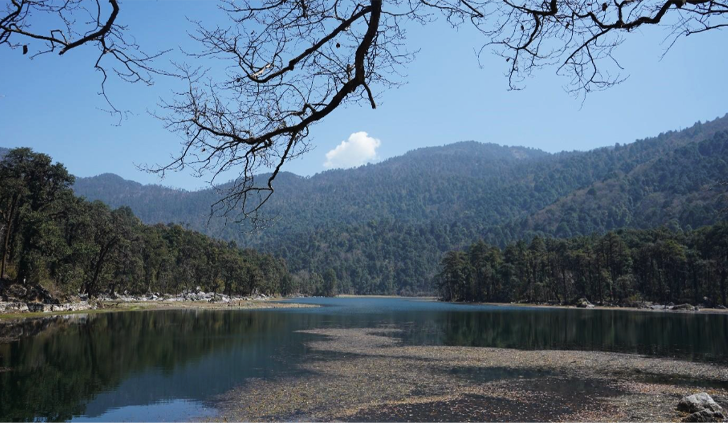
A view of Ramaroshan Lake and community forest in Accham district
This progress comes despite persistent challenges: uneven governance capacity, regulatory bottlenecks, and limited market access continue to constrain community livelihoods. Intensifying wildfires, delays in renewing operational plans, and rising human–wildlife conflict add further pressure. Yet institutional capacity has strengthened in parallel, with REDD+ focal points established in every province and REDD cells operating across districts.
These investments mean Nepal is strengthening its institutions, data systems, safeguards and partnerships required to participate in high-integrity carbon markets—capacity that enabled the country to secure its first ERPA for a programme which will apply ART-TREES. What began as local stewardship now connects directly to global results-based finance.