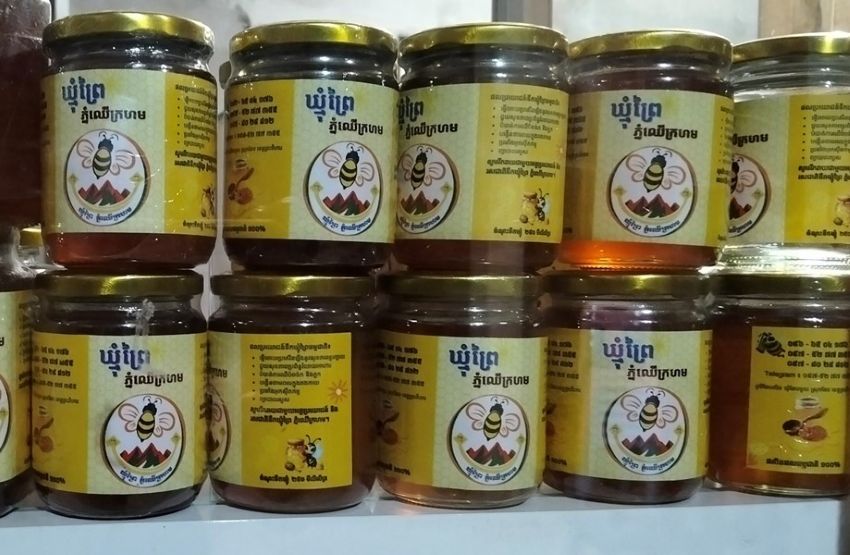
Figure 1. Honey production supports forest protection and increases household income—an example of NbS in Cambodia’s Chhaeb Lech Community Forest.
Source: Presentation at ASEAN Regional Workshop on developing ASEAN Toolkit on NbS/EbA in the Forestry Sector, including Social Forestry, 2–3 May 2025. Bali, FAO.
Across the Association of Southeast Asian Nations (ASEAN), forests are increasingly recognised not only as vital ecosystems and a source of well-being for local communities but also as a key part of the region’s response to climate change, biodiversity loss, and rural poverty.
This is especially true for social forestry which places local communities at the centre of forest management and offers an important pathway for linking environmental goals with local development. As the ASEAN Member States (AMS), whose forests cover approximately 203.6 million ha work to strengthen climate resilience, advance sustainable forest management, and support forest-dependent communities, there is growing demand for practical guidance on how Nature-based Solutions (NbS) / Ecosystem-based Approaches (EbA) can be applied in the forestry sector that are both credible and implementable across diverse national contexts. The new ASEAN Guidelines on Nature-based Solutions and Ecosystem-based Approaches in the Forestry Sector and the accompanying ASEAN Toolkit on Nature-based Solutions and Ecosystem-based Approaches in the Forestry Sector, including Social Forestry, respond to that need.
The Guidelines and Toolkit were developed by the ASEAN Secretariat, through technical assistance of FAO and Nanyang Technological University (NTU) under the Swiss Agency for Development and Cooperation (SDC) supported UN-REDD “ASEAN Social Forestry Initiative” (2022-2026).
These two resources are a product of a collaborative and consultative process involving the ASEAN Working Groups on Forest and Climate Change (AWG-FCC) and Social Forestry (AWG-SF), as well as inputs from government representatives, experts, civil society, and private sector actors. The Guidelines and Toolkit are intended to support AMS move from broad ambition to more concrete action in forestry, including social forestry, by offering both a shared framework and practical tools for implementation.
The distinction between the two documents is important. The Guidelines provide a higher-level framework. They are designed mainly for policy and decision makers, and set out guiding principles to help AMS mainstream NbS into forestry-related policies, programs, and investments.
The Toolkit is the practical companion document. It is aimed not only at policymakers but also at practitioners and community stakeholders, helping users to identify opportunities, assess interventions, and strengthen implementation in different forest landscapes. In other words, the Guidelines help answer why NbS matters and what should guide action, while the Toolkit helps show how this can be applied in practice.
At the heart of the Toolkit is the simple, but practical idea of the “Triple-win”. Rather than treating climate, biodiversity, and livelihoods as separate agendas, the Toolkit encourages approaches that can deliver benefits across all three. This includes climate change mitigation and adaptation, biodiversity conservation and ecosystem restoration, and socioeconomic gains such as stronger livelihoods, community resilience, and more inclusive forest governance. In the ASEAN context, where forests support millions of people and where climate-related risks are intensifying, this integrated approach is especially relevant. It is also particularly important for social forestry, where local communities are not just beneficiaries of better forest management, but key actors in making it work

Figure 2. The NbS Triple Wins Framework in ASEAN toolkit on nature-based solutions and ecosysem-based approaches in the forestry sector, including social forestry.
The Toolkit is signed to make these ideas usable. It includes an assessment matrix, a decision-support tree, regional case studies, and practical recommendations to help users design, assess, and strengthen NbS/EbA interventions in forestry, including social forestry. It also recognises that successful implementation depends on more than good technical design. Clear tenure rights, inclusive participation, policy coherence, monitoring, finance, and cross-sector collaboration all matter. Toolkit’s practical value is likely to be strongest: helping governments, practitioners, and partners think through what high-quality implementation looks like in real landscapes and national contexts.
The launch of the Guidelines and Toolkit, planned for mid-2026, also comes at an important time in ASEAN’s wider policy landscape. The ASEAN Food, Agriculture and Forestry Sectoral Plan 2026–2030 gives strong regional backing to sustainable forest management, climate resilience, decarbonization, and community engagement. It explicitly highlights the importance of promoting NbS/EbA in the forestry sector, supporting social forestry and agroforestry, strengthening community-based natural resource management, improving forest monitoring, and enhancing access to finance, markets, and value chains for social forestry products. In that sense, the Guidelines and Toolkit are not standalone publications; they are timely resources that can help AMS advance priorities already reflected in the region’s evolving agenda for forestry and sustainable development.

Figure 3. NbS principles in the ASEAN guidelines highlight customary (adat) forests, such as the Ammatoa Kajang in South Sulawesi, Indonesia.
Source: Presentation at ASEAN Regional Workshop on Developing the Toolkit on Nature-based Solutions (NbS) and Ecosystem-based Approaches (EbA) in the Forestry Sector, including Social Forestry, 2–3 May 2025. Bali, FAO.
Just as importantly, the launch is not the end of the story. Under the 2026-2030 UN-REDD framework, SDC will continue supporting ASEAN in its efforts to progress social forestry and further empower communities; governments and other stakeholders will be supported to put the Guidelines and Toolkit into use.
This will include helping relevant actors apply them in policy and planning processes, strengthening capacities, and piloting their use in social forestry landscapes. This new planned cooperation offers an important opportunity to generate practical learning from implementation, refine approaches based on experience, and build momentum for wider uptake across the region. For a set of resources intended to bridge the gap between principles and practice, continued support will be crucial.
The online launch event will bring together key partners, including the ASEAN Secretariat, the ASEAN Working Groups on Social Forestry and Forest and Climate Change, the UN-REDD Programme, and other international partners. More than a publication launch, it marks an important step in strengthening ASEAN’s shared approach to forestry, climate action, and community-centered landscape governance. With social forestry firmly in focus, these new resources offer a timely reminder that effective climate and biodiversity action in ASEAN will depend not only on protecting forests, but also on supporting the people and institutions that steward them.