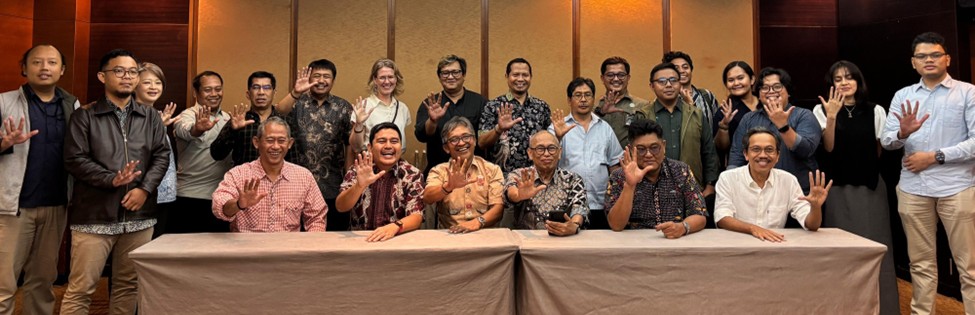
Taskforce kick-off meeting (Photo credit: UNDP Indonesia)
At the United for Wildlife Global Summit and High-Level Ministerial Roundtable in Rio de Janeiro, Brazil on 4 November 2025, the Indonesian Minister of Forestry, Raja Juli Antoni recognized Indigenous Peoples and local communities as the true guardians of the Indonesian forests.
With this, the country also committed to recognize 1.4 million hectares of new customary forests (Hutan Adat) by 2029. Additionally, Indonesia also endorsed the Intergovernmental Land Tenure Commitment at UNFCCC COP 30 in Belem, Brazil. This was a momentous announcement by a country with over 300 ethnic groups spread across the archipelago of which over 25,000 indigenous villages are in and around forest areas[1].
Indonesia’s bold commitment came on the back of a Ministerial Decree No. 144 of 2025, by the Ministry of Forestry in March 2025, which established a Special Task Force to Accelerate the Recognition of Customary Forests. While the roles and rights of the Adat Law Communities (Masyarakat Hukum Adat) have been recognized in the 1945 Constitution, complemented by Law No. 41 of 1999 on Forestry, a Constitutional Court Decision No. 35/PUU-X/2012 provided a landmark ruling on the material test for Law No. 41 of 1999. The Court ruled, among others, that customary forests are forests within the territory of Adat Law Communities, and not part of state forests. Furthermore, the government is ordered to establish customary forests as long as the Adat Law Communities in question still exist and are recognized by law.
Customary forests in Indonesia
Customary forests are recognized as one of the five schemes under the national Social Forestry program. More significantly, it is a pathway to full customary land title recognition for most Adat communities. As of October 2025, there are 164 Adat Law Communities with over 345,000 hectares of customary forests, benefiting 88,000 households. As such, what Ministerial Decree No. 144 of 2025 seeks to achieve is to further unlock the bottlenecks which impede the legal recognition of customary forests. What adds to the challenge is that the existing Adat Communities must be legally recognized in tandem with their customary forests. The process is complex and time-consuming as some instances require measures to clarify overlapping permits within Adat territories, resolve inter and intra conflicts, among others.
UN-REDD programme support
With funding from the Norwegian International Climate and Forest Initiative (NICFI), UNDP through the UN-REDD Programme (Programme), is supporting the implementation of Ministerial Decree No. 144 of 2025. Through partnership with the Directorate of Tenurial Conflict Management and Customary Forests (PKTHA) of the Ministry of Forestry, key long-standing civil society and Indigenous Peoples organizations (CSOs and IPOs), we have developed a roadmap for the multi-stakeholder Task Force (TF).
Among its tasks is consolidation of a database for customary forests which draws from groundwork by CSOs on Adat Communities. The shared data is reviewed by a multi-stakeholder technical group before it undergoes validation in four regions, in coordination with CSOs and IPOs, and is integrated as part of the final national decision-making process. The result will be an updated map for the status of Customary Forests throughout Indonesia.
Another key area of work is strengthening the capacity of the Adat Forests field verification teams. A training module by PKTHA was recently developed in collaboration with CSOs and IPOs, followed by a series of on-going regional training where 44 new field verifiers from Jawa, Bali and Nusa Tenggara provinces have been certified to date. In December 2025, field verification for Customary Forests of three Adat Law Communities will take place in North Kalimantan province. In addition, Indonesia also prepared a video which communicated its progress on Customary Forests and was widely shown at the UNFCCC COP 30 in Belem, Brazil. Additional communication materials have been planned over the next few months.
This is just a renewed beginning for the work on Customary Forests and Adat Law Communities in Indonesia. The path ahead will continue to be challenging, but through the collaborative partnership between the Government of Indonesia, key CSOs, IPOs, academia, UNDP through the Programme, and with international partners such as NICFI, the role of Adat Law Communities as forest guardians in Indonesia will continue to gain momentum.
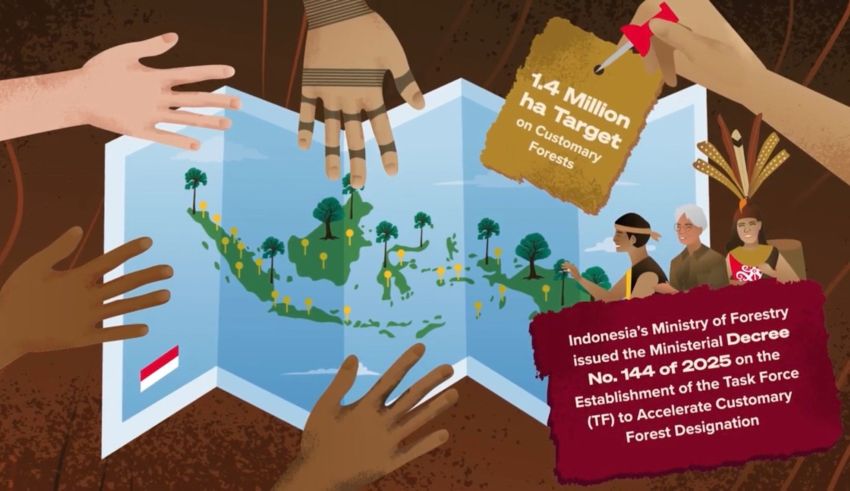
Animation on the role of Forest Guardians in Indonesia
[1] Source: Indonesia Population Census 2010