At a small mill on the edge of Gunung Kidul’s limestone hills, men are slicing freshly cut teak logs—each tagged with chalk markings—into even planks. It is a quiet symbol of how community forestry in Indonesia and the region is changing.
“We help farmers get better prices for their timber by improving efficiency. When production costs drop, their income increases,” says Puji Raharjo, the cooperative manager of Wana Manunggal Lestari (KWML).
Across ASEAN, similar enterprises are emerging under the Social Forestry models—linking communities, forests, and markets in ways that sustain both people and nature. Formerly isolated smallholders are now increasingly getting organized as producers supporting livelihoods and climate and forest resilience.
In Yogyakarta’s uplands, cooperatives like Raharjo’s guide farmers on everything from felling techniques to record-keeping. “We help them plan which trees to cut and when,” he explains. “Even how the wood is sawn can change its value.”
Certification has been central to this progress. “We meet the standards of the Forest Stewardship Council,” Raharjo says. “That means replanting after harvest and avoiding hazardous materials.”
“It’s how we make sure something stands for our children,” says Suparijem at nearby Menur Forest Farmers Group, which follows the same approach. The new system, which includes precise measurement of trunk diameter and height, has ended the guesswork that once shaped local timber prices.
The cooperative model has also become a platform for teaching younger villagers. “When the youth see real returns, they start believing forestry has a future,” Suparijem adds.
However, Surati, from the Sedyo Makmur Community Forest, mentions that regeneration is still a challenge. “Young people want quick income while forestry takes time,” she says. “But if they can see that timber gives long-term stability, they’ll join.”
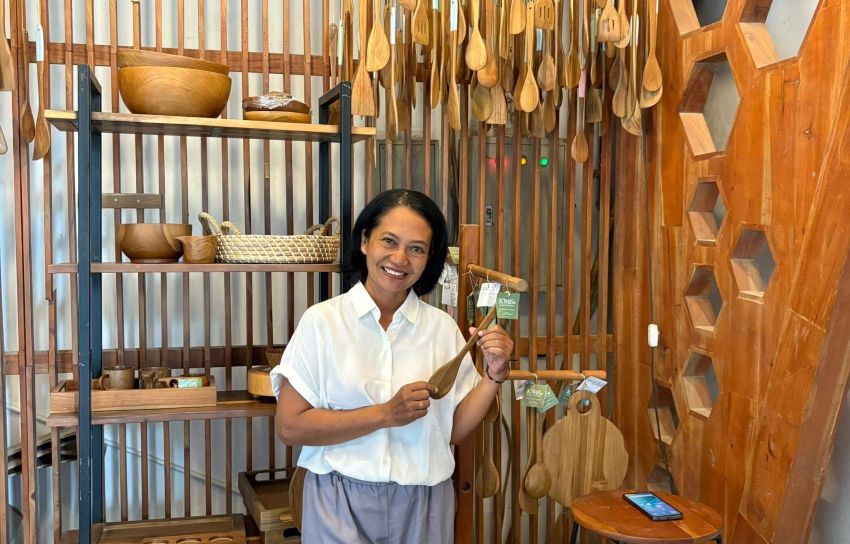
Local processors are part of that equation. R. Agung Prasetya, who runs CV. KWaS in Bantul, produces FSC-certified wooden kitchenware using timber from nearby cooperatives. “We began working together after they received certification in 2022,” he says. “The quality is good and we’ve never faced shortages. It’s efficient for us and fair for them.” His business now employs about seventy workers directly and over a hundred through subcontractors, showing that community timber can sustain competitive industries.
From local effort to regional strategy
Government support has helped turn such partnerships into policy. Kusno Wibowo, Head of Yogyakarta’s Environmental and Forestry Agency, explains: “Social forestry connects livelihoods with conservation. Farmers get technical guidance, seedlings, and market support.”
Yogyakarta’s 1,600 hectares of social forestry are managed by 45 groups. Farmers earn from short-term crops between trees but rely on teak as the long-term anchor. “Each layer supports a family’s stability,” Kusno says. “The long-term harvest funds education and housing; the short-term crops feed the household.”
Still, limited access to finance remains the main bottleneck. Sabam Benedictus Silalahi, Head of the Forest Management Unit, notes: “We need investors who see both the social and economic value.” He points to under-story products such as herbs that can complement timber production. “Partnerships with the private sector can multiply benefits while keeping forest cover intact.”
Such partnerships are now central to regional cooperation. Through the UN-REDD Climate Change Mitigation through Social Forestry Actions in ASEAN Countries initiative—implemented with RECOFTC and NTFP-EP and supported by the Swiss Agency for Development Cooperation (SDC)—the United Nations Environment Programme (UNEP) supports cooperatives build investment readiness and strengthen forest-friendly supply chains. This includes technical and financial guidance, business-plan development, and links to investors to place local SFEs on sustainable economic pathways.
“Southeast Asia is rich in forests and biodiversity but is losing them fast. It’s causing huge emissions and putting people’s livelihoods, food, and resilience at risk,” says Tessa Nerini, Deputy Head Political, Economic and Cultural Division, Embassy of Switzerland, Indonesia. “That’s why Switzerland and ASEAN work together on social forestry and climate action.”
According to the State of Finance for Forests 2025 report, global private finance for forests reached about US$ 7.5 billion in 2023—yet less than a tenth of that reached community-based or smallholder forestry. Certified forest products alone attracted US$ 2.27 billion in investment, nearly four-fifths of all certified commodity spending. Most of that capital still circulates in developed markets, leaving tropical forest regions—where nearly all deforestation occurs—vastly underfunded. For ASEAN’s growing sustainable timber enterprises, this points to a clear opportunity: to channel future investment where sustainable forestry can yield both climate and community dividends.
Across the region, new models are emerging. In Cambodia, UNEP and partners helped three Community Forests (CFs) in Kampong Thom Province develop business and investment plans that combine eco-tourism and timber-based activities to generate steady incomes. The initiative also supports legal firewood sales from forest thinnings and CF member-funded tree plantations under government-approved plans.
The CFs utilized their Community Forest Development Funds (CFDFs) to invest in silviculture treatments.
These CFs, known for collective action and strict compliance with transport and trade regulations, show how communities can engage in legal and sustainable wood supply chains. With facilitation from the Forestry Administration Cantonment, they ensured lawful trade and reliable buyer access, demonstrating that coordinated governance and legal adherence can open formal market opportunities.
“We used to view trees only as something to cut,” says Mr. Mean Mom, a community leader in Kampong Thom. “Now we think about how to manage and replant.”
Women-led cooperatives are also taking shape. They are learning the ropes: from measurements, prices, and replantation techniques.
To consolidate these gains, ASEAN has developed the Blueprint for Accelerating the Business Development of Social Forestry Enterprises—a regional framework built on lessons from Indonesia, Cambodia, and Lao PDR. The Blueprint outlines how governments can strengthen governance, market access, and investment readiness, while promoting cooperation and learning across member states.
These stories—of cooperatives that replant, of women who manage timber plots, of youth slowly returning to forestry—show how local action can drive global outcomes. They also reveal what still stands in the way: affordable finance, modern processing, and stronger value-chain partnerships.