Riau is on track to translate its climate ambitions into tangible results for the province and its people.
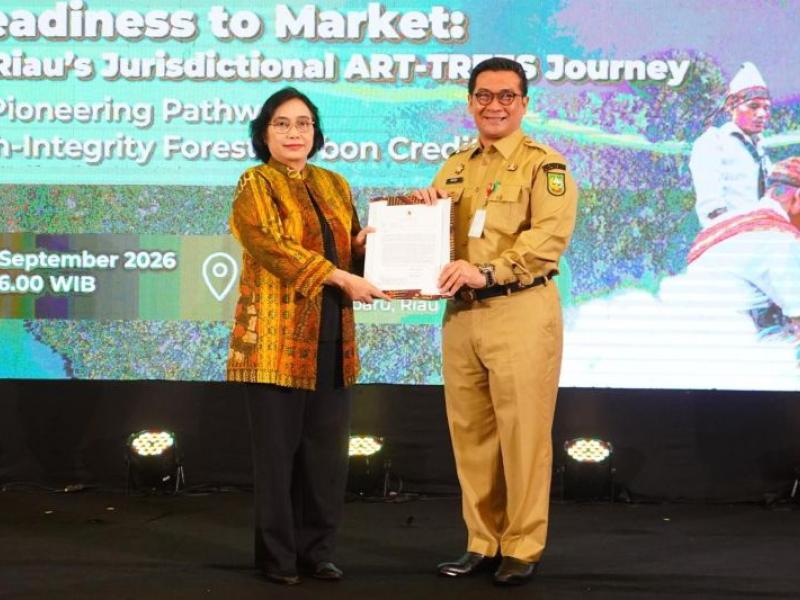
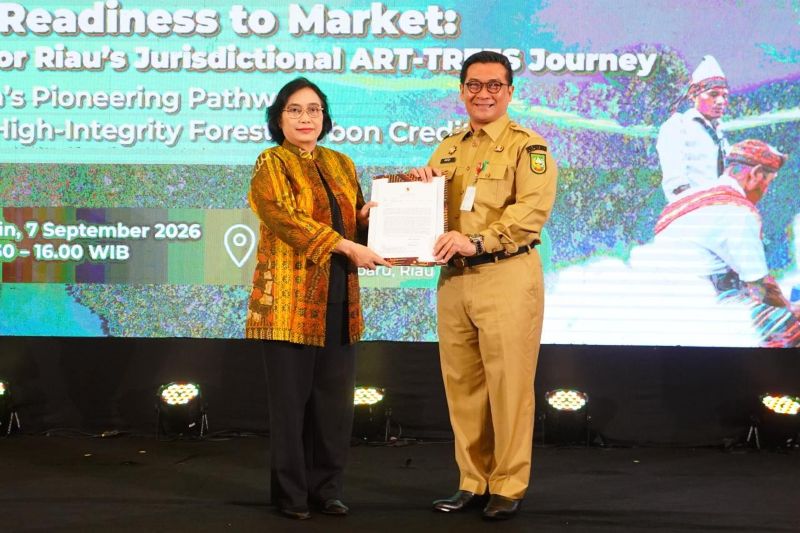
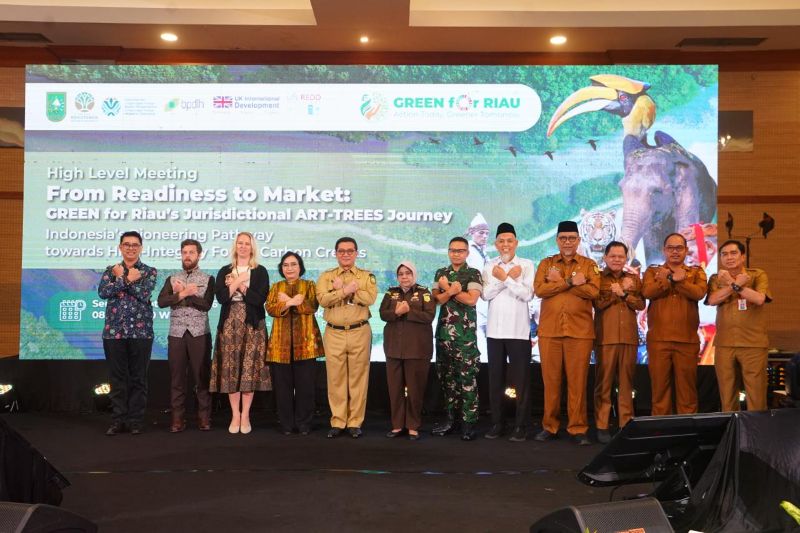
Riau is positioning itself to become one of Indonesia’s leading jurisdictions for high-integrity forest-carbon transactions. By early 2026, the country's largest peatland province has advanced the preparation of the concept document required to pursue registration under the Architecture for REDD+ Transactions and its REDD+ Environmental Excellence Standard, known as ART-TREES. Before the submission goes forward, the Ministry of Forestry wants one question settled on how emission reductions already claimed by two carbon-private projects will fit into the province's ledger, so that Riau's first claim is beyond dispute. On September 7, the Ministry offered its formal endorsement.
This process—integrating project-level and other emission-reduction activities within a jurisdictional accounting framework—is commonly referred to as “nesting.” In Riau, nesting is not simply a technical exercise; it also requires agreement on data, baselines, eligibility, carbon rights, safeguards, and the treatment of existing claims.
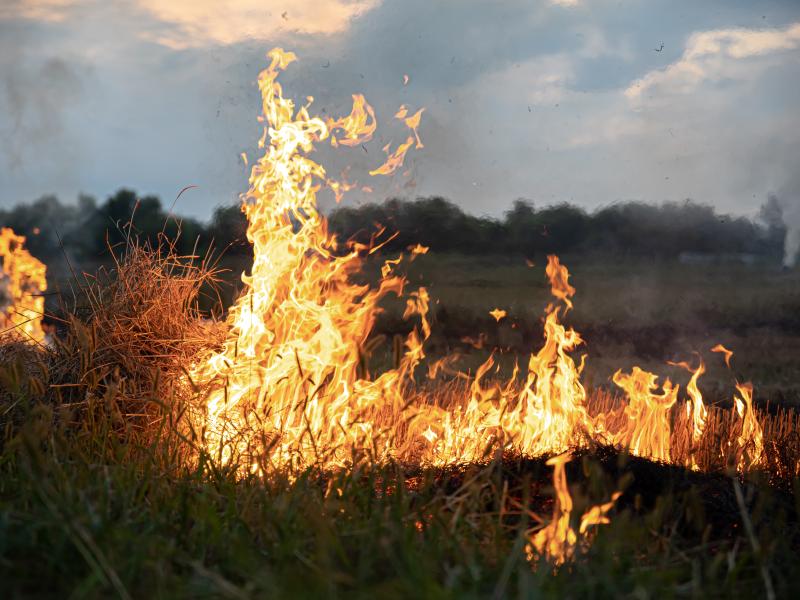
Much of Riau's carbon sits not in its trees but beneath them, in peat accumulated over centuries. Drained, it oxidizes and burns: in July 2025, hundreds of fire hotspots flared in a single day, sending smoke across the Strait of Malacca. Keeping that carbon in the ground means keeping the water table high—and making wet peat worth more than dry.
Rather than crediting carbon project by project, Riau is counting verified emission reductions across roughly 2.6 million hectares of forested land against an independently assessed baseline. Technical support comes through the GREEN for Riau Initiative, implemented through the United Nations Collaborative Programme on Reducing Emissions from Deforestation and Forest Degradation (UN-REDD)-led by the UN Environment Programme with the Food and Agriculture Organizationand funded by the United Kingdom.
But these forests were never an empty landscape waiting for a market. Restorasi Ekosistem Riau (RER), a peatland restoration programme established in 2013 by APRIL Group, one of the world's largest pulp-and-paper producers, manages about 130,000 hectares on and around the Kampar Peninsula, while a second licence holder, PT Suntara Gajapati, runs a peatland programme of its own across roughly 20,000 hectares. By RER's own account, the company figure calculated under Verra's VM0007 methodology and yet to be reconciled with provincial data, its concession avoids some 6.5 million tonnes of carbon dioxide equivalent a year by forgoing planned deforestation across a peat-dominated landscape: half of the roughly 13 million tonnes the whole accounting area is estimated to avoid from unplanned deforestation, from just five per cent of its land.
If both company and province count those tonnes, neither claim holds. Nesting is the fix: one provincial framework for baselines, monitoring and accounting, so no tonne is sold twice.
It sounds like accounting. In practice it is a negotiation over data, rights and future revenue—and it is not finished.
Riau’s experience is becoming increasingly relevant to Indonesia’s national carbon-market architecture. On 6 April 2026, the Minister of Forestry issued Regulation No. 6 of 2026 on procedures for carbon trading through greenhouse-gas emission offsets in the forestry sector. The regulation provides for jurisdictional programmes and requires nesting for carbon generated through jurisdictional programmes, with nesting intended to prevent double counting and double claims. Riau’s readiness work therefore sits within a broader national effort to establish clearer rules for integrating jurisdictional and project-level forest-carbon activities.Riau's groundwork has informed broader discussion on jurisdictional REDD+ and nesting in Indonesia, which also produced the country's first national workshop on nesting, held in Jakarta with UN-REDD support.
“We are committed to unlocking the full potential of our forests, not only to advance our climate ambitions, but also to create predictable financial pathways that support communities and forest stewards," said Laksmi Wijayanti, the Ministry of Forestry's Director General of Sustainable Forest Management.
Restraint has become part of the method. The provincial and national technical team has focused on launching with the smaller area, whose emissions baseline is already calculated and validated, and leaving peat, with its tenure conflicts and unsettled crediting methodology, for a later round. The choice remains open, but the instinct is conservative: a smaller, defensible first claim over a larger, contestable one.
The same principle applies to who benefits. Programme mapping has identified indigenous and local communities within the proposed accounting area, while formal recognition of customary communities remains more limited. The programme has therefore developed Free, Prior and Informed Consent (FPIC/PADIATAPA) protocols and involved Lembaga Adat Melayu Riau (LAMR) in safeguards-related processes. The key issue is not only participation, but whether rights-holders can influence decisions on land, carbon rights, benefit sharing and grievance resolution before carbon-related claims are finalized. Any proposed allocation-such as directing 80 per cent of carbon-related revenues to communities, indigenous groups and local governments—should be presented clearly as a proposed benefit-sharing arrangement unless it has already been formally adopted.
"The forest is our grandchildren's inheritance. If we lose it, our lives and identity will fade as well," said Marjohan Yusuf, chairman of Lembaga Adat Melayu Riau.
Riau has issued no credits and completed no transaction so far, and independent verification will require substantial upfront financing. East Kalimantan and Jambi needed more than five years to secure agreement from its stakeholders. Riau is trying to move faster without skipping the consent and the due diligence.
Its significance lies in resolving those questions before the first transaction rather than after the first dispute. A province long associated with forest and peatland fires may yet become known for something rarer: a carbon ledger that is transparent, nested, rights-respecting and trusted by the people whose forests generate the value.