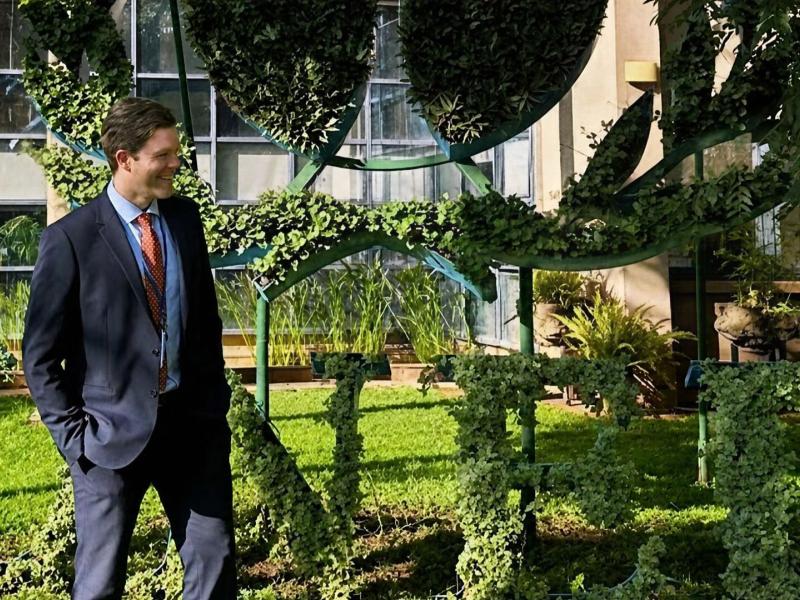
From left to right: Mr. Agus Rusli (Director of Waste Reduction and Circular Economy Development, Ministry of Environment) – Mr. Joko Tri Haryanto (IEF Executive Director) - Ms. Haruni Krisnawati (Senior Advisor on Climate Change, Ministry of Environment) – Mr. Norimasa Shimomura (Resident Representative, UNDP Indonesia) – Mr. Saiful Islam (Director of Investment Management System, Ministry of Finance) – Ms. Dwi Irianti (Director of Sharia Social Finance, National Committee for Sharia Economy and Finance).
What does it mean to make climate finance truly inclusive?
In Indonesia, that question is being answered through an unlikely but powerful pairing: faith and forest conservation.
On 28 May, the Indonesian Environment Fund (IEF), with support from the UN-REDD Programme through UNDP, launched a new ‘Sharia-compliant Revolving Fund Facility’ to support social forestry groups. The facility introduces a financing model rooted in Islamic financial principles—offering an interest-free, ethical alternative that many rural communities and cooperatives find more accessible and culturally aligned.
Preserving livelihoods without cutting trees
At its core is a simple but significant idea: that communities should not be forced to choose between their livelihoods and their forests. The scheme’s flagship model, known as “deferred tree cutting loan,” allows borrowers to meet their financial needs without harvesting trees prematurely. Instead, standing forests are preserved as long-term carbon assets while communities receive the support they need to pursue alternative income sources.
This approach is especially relevant in Indonesia, where more than 80 percent of the population identifies as Muslim. For many cooperatives—such as those operating under a Sharia mandate—accessing conventional loans is either discouraged or prohibited. Until now, this has left a gap in reaching groups that are often closest to forest landscapes, yet furthest from formal financing systems.
Voices from the ground: “This opens new possibilities”
“We have long worked in rural areas, often near forests,” said Mulyadi from KSSPPS Mitra Dhuafa (KOMIDA) Syariah, a Sharia-based cooperative in Aceh that serves thousands of women entrepreneurs. “But because of our Syariah principles, we can’t turn to conventional finance. This model opens new possibilities—if it’s done in a way that’s practical and clear.”
KOMIDA is one of the many cooperatives showing interest in the new facility. While not directly engaged in forest management, 90 percent of its members depend on land-based livelihoods that intersect with Indonesia’s forest ecosystems. Their feedback also highlights a common theme: finance alone is not enough. Long-term forest protection also depends on awareness, education, and the ability to build trust between financial institutions and communities.
Expanding the toolbox, not replacing it
From IEF’s perspective, the new scheme is not about replacing existing models—it’s about expanding the toolbox.
“This facility allows us to reach communities that were previously excluded,” said Joko Tri Haryanto, IEF Executive Director. “With support from UN-REDD through UNDP, we have been able to design a mechanism that aligns with local values while supporting national climate targets.”
Laying the groundwork for success
Behind the scenes, the pilot has involved detailed works to prepare internal regulations, engage Sharia advisors, and train more than 59 field facilitators who will support implementation on the ground, of whom 7 were women. Partnerships with Islamic financial institutions and cooperatives are also underway, forming the foundation for broader rollout.
For the UN-REDD Programme, Indonesia’s innovation offers an important lesson: that REDD+ strategies can—and should—be tailored to local realities. Whether that means working with Indigenous knowledge systems, adapting to gender norms, or aligning with faith-based financial structures, flexibility is key to achieving impact.
A scalable model for values-driven climate finance
As a partner in the UN-REDD Programme, UNDP recognizes that there is no universal blueprint for inclusive climate action. Listening to communities and responding to their realities has resulted in co-creating solutions that work for both people and the forests.
As Indonesia moves forward with full-scale implementation, the hope is that the Sharia-based model can grow beyond its pilot phase to serve as a scalable example of values-driven climate finance.
And perhaps, in doing so, it can also inspire other countries to ask a similar question: what does inclusivity really look like in our context?
Sometimes, the answer lies not in what we add, but in what we are willing to adapt—so that the forest, our beliefs , and the future can all thrive together.