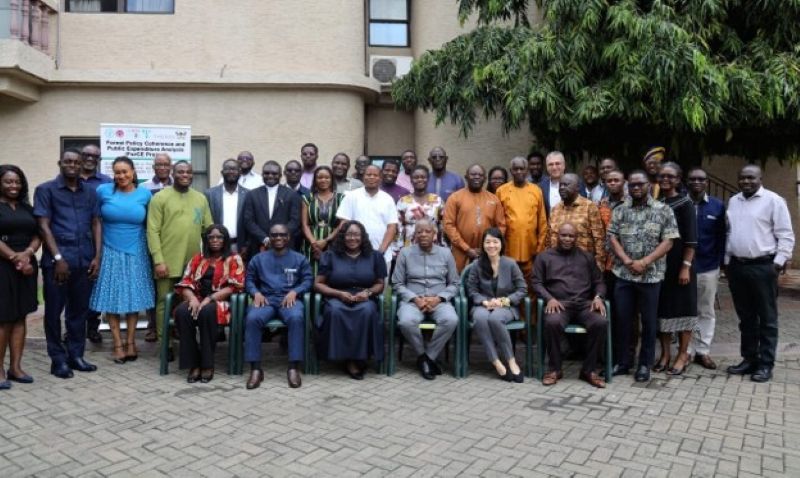
Accra, Ghana — On Tuesday, 26th May 2026, a high-level stakeholder workshop was convened at the Miklin Hotel, East Legon, to review and validate the final draft of the policy coherence analytical framework under the Forest Policy Coherence and Public Expenditure Analysis (FoRCE) initiative.
The initiative is led by FAO in the contexts of UN-REDD Programme and is implemented through a collaborative partnership between the CSIR-Forestry Research Institute of Ghana (FORIG), the Thünen Institute, and Makerere University. The central aim of the workshop was to gather multi-stakeholder feedback to refine a framework that evaluates how existing policy instruments interact within the Agriculture, Forestry, and Other Land Use (AFOLU) sectors.
Delivering the opening remarks, Dr. Joseph Appiah-Gyapong, the Acting Director of the Climate Change Unit at the Forestry Commission of Ghana, underscored the complex challenges plaguing the landscape. He noted that combating persistent issues like deforestation, illegal land-use activities, and accelerating climate change demands more than isolated interventions. Instead, it requires stringently coordinated policy frameworks, highly effective governance structures, and the strategic allocation of public funds.
The FoRCE initiative aims to address these exact needs by integrating Forestry Public Expenditure Reviews (PERs) to examine how public investments can be structurally optimized to support viable livelihoods and forest conservation simultaneously.
The technical sessions featured comprehensive presentations highlighting preliminary findings from current policy analysis and public expenditure evaluations.
The diverse panel of presenters included:
- Ms. Naoko Takahashi representing the Food and Agriculture Organization (FAO).
- Dr. Richard Fischer from the Thünen Institute of Forestry, Germany.
- Dr. Jewel Andoh from the CSIR-Forestry Research Institute of Ghana (CSIR-FORIG).
Participants were organized into seven groups designed to optimize stakeholder inputs on the draft analytical framework, sharing findings from sector policy coherence analyses, evaluating the effectiveness of existing policy instruments, and assessing their long-term relevance.
The workshop brought together approximately 40 expert participants, bridging the gap between state bodies such as the Ministry of Agriculture, COCOBOD, Ministry of Lands and Natural Resources, and the Environmental Protection Authority and local farmers, academia, and Civil Society Organizations (CSOs).
In his closing remarks, Dr. Kwame Antwi Oduro, Director of CSIR-FORIG, thanked the participants for their invaluable contributions and emphasized that the finalized framework would serve as a bedrock for future policy formulation, ensuring that public resources are effectively deployed to achieve a balance between sustainable agricultural production and robust forest conservation in Ghana. The workshop program was seamlessly facilitated by Dr. Elizabeth Obeng as the Master of Ceremony.
Looking ahead, FORIG will incorporate stakeholder feedback on the perceived effectiveness from the workshop into the final policy coherence analysis while FAO working with the Ghana Forestry Commission in strengthening the analysis linking public expenditure to specific policy instruments, by exploring more detailed expenditure analysis to better understand how public finance supports policy implementation.
The FAO–FORIG team aims to finalize the Ghana policy coherence and public expenditure study this year, alongside a parallel pilot in Uganda. Lessons from both countries will inform the development and publication of a policy coherence analytical framework that uses public expenditure as a key input, providing a practical tool for other countries to improve policy coherence, optimize public financing across land-use sectors, reduce deforestation, and promote sustainable economic development.
Contact: Naoko Takahashi Forestry Officer