Social forestry (SF) has been expanding in Southeast Asia for over 40 years. Between 2010 and 2024, the area under SF grew from 6.7 to over 15.3 million hectares. This growth has coincided with stronger legal frameworks that secure rights and deliver greater benefits to local tenure holders.
Expansion is set to continue with, for example, Cambodia targeting 2 million hectares of SF by 2029 (31.6% of 2025 forest area), Indonesia 12.7 million hectares by 2030 (13.2%), while in Lao PDR the potential is approximately 6 million ha by 2030 (46.0%).
Natural forests in the region have long been under pressure. SF was introduced to counter this by granting secure tenure rights to local communities, encouraging investment in forest protection and management. The incentives are stronger where SF also creates clear livelihood opportunities.
In Lao PDR, SF, known as Village Forestry (VF), is legally recognised in the 2019 revised Forestry Law, though it was practiced for years before the revised Law came into force. New policies and initiatives, especially the “Action Plan for the Recognition of Land Use Rights in Forestland”, could further strengthen village tenure and help achieve Lao PDR’s 70% forest area target. The Action Plan aims to issue land titles, land-use certificates, and Village Forest Management and Protection contracts to households in 2,690 villages by 2030.
The importance of Village Forest Management is highlighted in the new policies, for example, the Ministry of Agriculture and Forestry (MAF) Instruction on Village Forest Management Planning (4143) emphasises the role of VF in addressing deforestation, ensuring the long-term health and biodiversity of the forest, as a source of food, traditional medicine, and non-timber forest products to support family incomes, as well as for climate resilience.
"Recognizing the land use rights of local communities is essential to improving livelihoods. Active participation from the community and all stakeholders is the heartbeat of success in managing, protecting, and developing our forests and forest lands." 4143/MAF.
As VF strengthens in Lao PDR with support from government agencies, donors, civil society, and FAO, the need to understand its impacts grows. Under the Swiss-funded UN-REDD Initiative Climate Change Mitigation through Social Forestry Actions in ASEAN Countries (also known as ASEAN Social Forestry), FAO is working with the governments of Cambodia, Indonesia, and Lao PDR, as well as UNEP, RECOFTC, and NTFP-EP to build evidence on SF’s climate mitigation role.
One key area is collaboration with Lao PDR’s VF Management Division (Department of Forestry) to assess the impact of VF on reducing greenhouse gas (GHG) emissions, both reductions (avoiding deforestation and degradation) and removals (through afforestation, reforestation, and revegetation). The work has various implications, including clarifying how different VF models and supporting projects deliver results.
Early findings confirm that VF helps reduce GHG emissions compared to areas without VF. Villages with management rights show more stable or declining emissions over time. This highlights the importance of formalising VF under the Action Plan and ensuring adequate community support to translate tenure rights into effective management.
These results strengthen the case for integrating VF into national climate strategies and related programs. They can guide policy, resource allocation, and the design of incentives for villages. The assessment also identified many villages as “potential VF,” offering a major opportunity to expand coverage and increase mitigation benefits. The Lao government has recognised this potential and is now beginning fundraising and implementation of the Action Plan. Moving forward, the next steps are:
- Strengthen the mitigation assessment through improved data quality. Address inconsistencies and gaps by developing and ensuring access to accurate spatial data, which is critical for reliable emissions estimates and systematic VF expansion. Refining activity data, integrating new datasets, enhancing monitoring systems, and improving nation-specific emission factors will also be essential.
- Support institutional coordination. Collaboration among forestry, land, geographic, and climate agencies is vital. A shared VF monitoring and reporting database, currently being developed by VFMD with FAO and partners, will help ensure consistency and transparency across institutions and projects.
- Capacity development. Priorities include developing a VF mitigation assessment manual, delivering training programs for technical staff, and translating technical outputs into accessible formats by developing a VF database on National Forest Monitoring System (NFMS). These efforts will help stakeholders better understand and track VF impacts at the project and program levels.
- Integrate findings into policy. Results should inform measurable VF targets in future Nationally Determined Contributions (NDCs) and reporting. Linking VF with national strategies such as the National Biodiversity Strategic Action Plan (NBSAP) and Payment for Ecosystem Services, while leveraging spatial tools for risk reduction and restoration planning, will further embed VF in national policy frameworks.
- Mobilise finance. Findings can also support government efforts to access climate and development finance. Scaling up VF in this way will maximise benefits for local communities, national development, and climate mitigation.
Looking ahead, developing a VFMS could be an important next step for the Lao PDR. By improving how data on village forests are collected, managed, and used, VFMS can help show where VF is delivering benefits for climate, biodiversity, and local livelihoods.
This kind of evidence will be critical not only for better planning and policy but also for supporting the priority and commitment of the government in the development of PES and other incentive-based approaches to achieve domestic sustainable finance mechanisms in the forestry sector. In this way, stronger monitoring can help connect village-level forest stewardship with wider national efforts to mobilise finance for sustainable forest management and rural development.
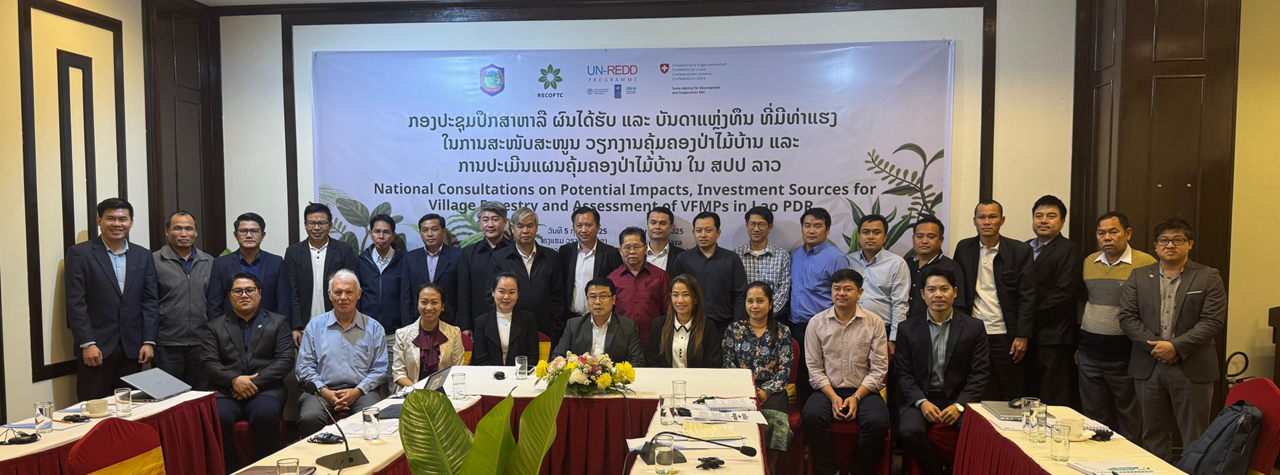
National Consultation Meeting, held in February 2025 on “Mobilizing finance for Village Forestry and Village Forestry Management Plans (VFMP) assessment in Lao PDR”. The work under ASEAN SF in Lao PDR, as well as in the other focus countries of Cambodia and Indonesia, is working to develop capacities on the use of VFMPs to support sustainable forest management, as well as enhancing reporting and monitoring.
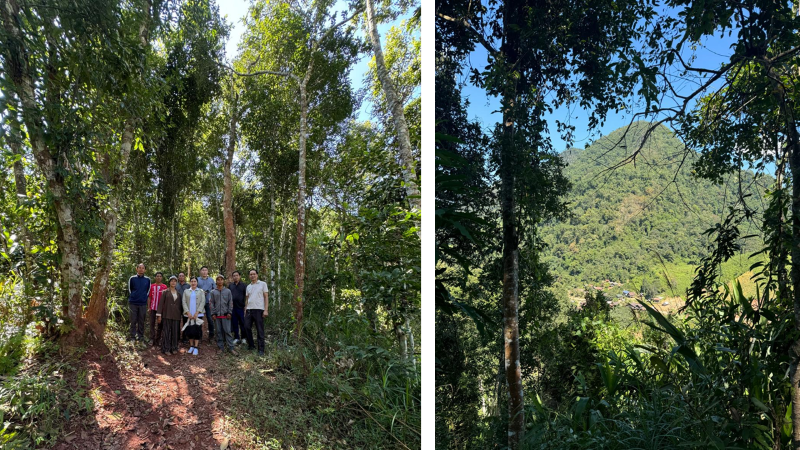
Fieldwork by FAO/UN-REDD and DoF assessing the use of VFMP in the Community Protection Forest of a village in Viengphoukha District, Luangnamtha Province. The research focused on how VFMP implementation supports climate mitigation and enhances local community protection efforts, as well as livelihood development.
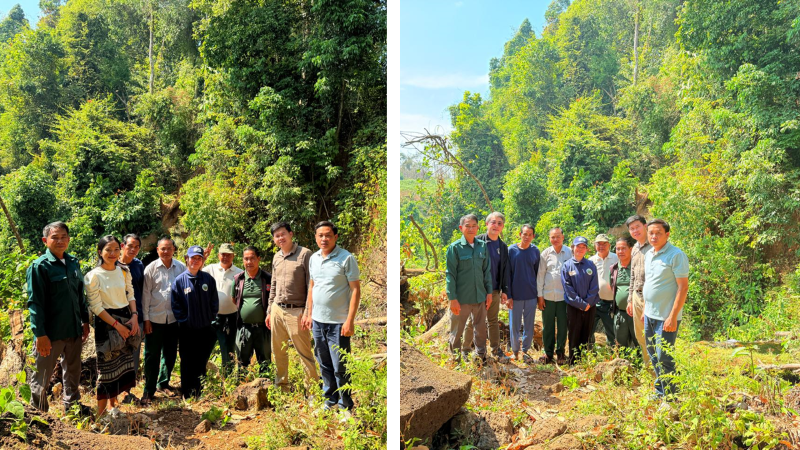
FAO/UN-REDD and DoF visiting a community restoration forest Dong Hua Sao National Protected Area, and having the opportunity to learn about community-driven environmental recovery, including its monitoring
References
FAO. 2025. Global Forest Resources Assessment 2025. Rome. https://doi.org/10.4060/cd6709en