Indigenous Peoples-led REDD+ initiatives are key to deliver benefits beyond emissions reductions
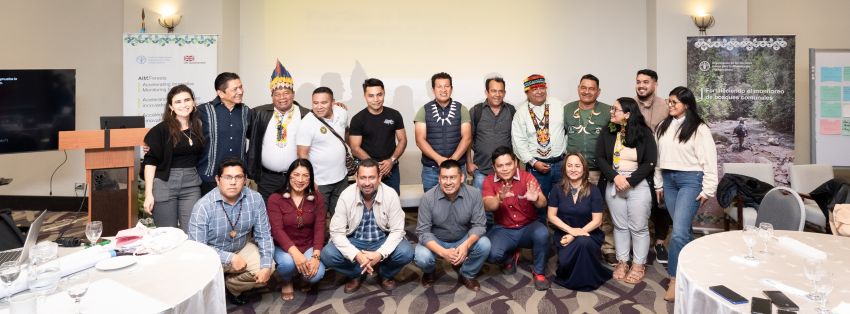
Across Latin America, Indigenous Peoples are redefining how forest conservation and climate finance mechanisms translate into tangible territorial benefits. Between 6-8 October 2025, Indigenous leaders and technical experts gathered in Lima to exchange experiences on forest monitoring, governance, and climate finance, particularly Jurisdictional REDD+.
Beyond sharing methodologies and technical advances, discussions focused on how these initiatives are reshaping local governance, revitalizing territorial management, and strengthening coordination between Indigenous organizations and government institutions. The dialogue also underscored how engagement in these processes has fostered new regional and global alliances among Indigenous Peoples who share a common vision of safeguarding forests while asserting their rights and leadership.
The event, convened by Grupo Perú a coalition of Indigenous Peoples organizations, composed of ANECAP, AIDESEP, and CONAP, and the Ministry of the Environment, with support of the Food and Agriculture Organization of the United Nations (FAO) through the AIM4Forests programme , and UN-REDD, brought together more than 45 Indigenous leaders and specialists from Mexico, Guatemala, Bolivia, Brazil, Ecuador, Colombia, Costa Rica, Panama, and Peru. brought together more than 45 Indigenous leaders and specialists from Mexico, Guatemala, Bolivia, Brazil, Ecuador, Colombia, Costa Rica, Panama, and Peru.
Building institutional resilience through multi-stakeholder platforms
Participants emphasized the enduring outcomes of climate finance such as REDD+ on their institutional capacities, and creation and maintenance of national and regional spaces for dialogue between Indigenous Peoples, governments, and civil society organizations. In many countries, these multi-stakeholder platforms have outlived individual projects and political cycles, helping to establish collaboration that is both consistent and credible.
In Costa Rica, for example, the REDD+ readiness process led to the formation of regional Indigenous coalitions and participatory platforms that continue to serve as mechanisms for consultation and shared decision-making. This continuity has helped maintain dialogue and cooperation through periods of political transition.
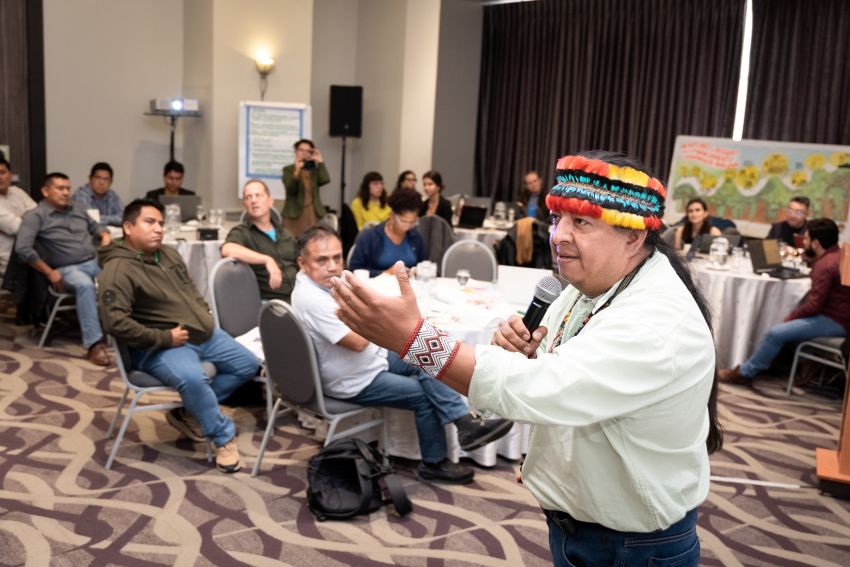
Capacity building has also been a key part of REDD+ readiness. In Panama, for example, training on safeguards, forest monitoring, and geographic information systems has strengthened community institutions and equipped them with skills that now serve a broader range of territorial management needs. These include monitoring illegal activities, improving land-use planning, and documenting land rights.
Mexico’s experience illustrates how REDD+ processes have evolved from technical readiness activities toward broader institutional strengthening. Indigenous Peoples organizations and their partners have contributed to the integration of social and environmental safeguards, as well as the recognition of Free, Prior and Informed Consent (FPIC), within national forestry legislation. The Mexican Network of Peasant and Forestry Organizations (Red MOCAF) has been central to this effort. Acting as a bridge between government institutions and Indigenous communities, ensuring that FPIC processes are both culturally appropriate and technically sound. This approach has been especially useful in contexts where mistrust between communities and public institutions could otherwise limit meaningful dialogue, and it is now attracting attention within jurisdictional REDD+ programs being developed in the country.
In Guatemala, supported by $52 million USD in funding through the FCPF, has helped establish strong governance structures at multiple levels, from community to national scales. These coordination mechanisms now serve purposes that go well beyond carbon accounting, including the distribution of benefits, conflict resolution, and long-term planning across forest communities.
Navigating the complexities of legal recognition
Discussions during the workshop also highlighted how REDD+ processes have accelerated progress on the fundamental issue of territorial rights. In Panama, a representative from the National Coordinator of Indigenous Peoples of Panama (CONAPIP) described how the development of a National Gender and Territorial Forestry Plan in 2024, initiated through REDD+ safeguard requirements, has strengthened the legal recognition of Indigenous Peoples communities to manage forest resources in line with their customary practices and priorities.
Participants emphasized that secure land tenure is not just a prerequisite for carbon initiatives, but a fundamental right that REDD+ processes have helped advance. The requirement for clearly defined land titles and territorial boundaries in carbon initiatives has, in several countries, acted as a catalyst for long-delayed land regularization efforts and prompted governments to address longstanding historical claims.
The missing pieces: What makes forest finance work for communities
The experiences shared in Lima reenforced the long-standing calls by Indigenous Peoples to implement REDD+ according to their realities, for improving livelihoods and sustaining conservation efforts, and adopting rights-based approaches that centre the focus on the critical non-carbon benefits and impacts of these initiatives, dependent on trust as much as on technical design (Read UN-REDD/UNEP’s recent report: High-risk forests, high-value returns: A co-benefits assessment for decision-makers, 2025).
As countries across Latin America work to scale up forest conservation while strengthening Indigenous Peoples land and resource rights, the lessons from this workshop suggest a more comprehensive approach to measuring impact. REDD+ and carbon initiatives should be evaluated not only on their financial performance but also on their ability to strengthen Indigenous Peoples governance, build institutional resilience, and support territorial autonomy.
Through its long-term engagement in the region, the UN-REDD Programme and its different knowledge platforms and communities of practices, continues to play a key role in supporting these efforts, helping countries and Indigenous Peoples organizations translate safeguards and governance principles into practice that advances both climate and social goals.