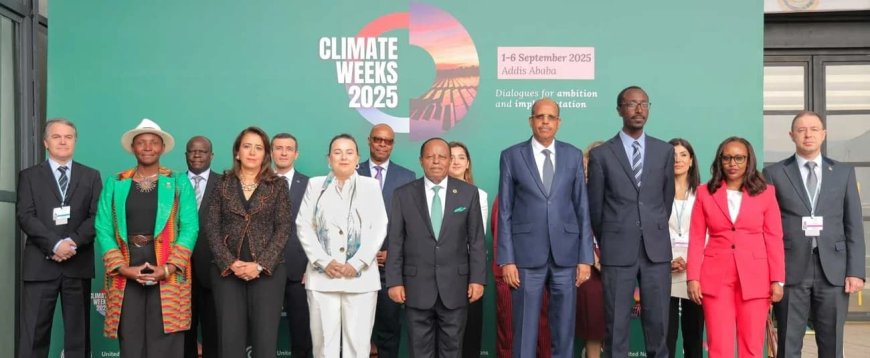
Ethiopian President Taye Atske Selassie (center) with AU Commission Chairperson Mahamoud Ali Youssouf (fourth from right), UNFCCC Deputy Executive Secretary Noura Hamladji (in white), and Ethiopia's Planning Minister Fitsum Assefa (second from right) at the launch of Climate Week. Photo credit: Thuku Kariuki/ StorySpotlight
Africa Climate Week (ACW) 2025 and the Second Africa Climate Summit (ACS2) concluded in Ethiopia with a resounding call for action: the time for pledges has passed, and Africa must now move decisively toward implementation. Convened under the theme “Accelerating Global Climate Solutions: Financing Africa’s Resilient and Green Development,” the week-long event brought together heads of state, policymakers, development partners, private sector leaders, and civil society groups from across the continent and beyond.
Africa’s Climate Reality
The urgency of the gathering could not have been clearer. Africa contributes less than four percent of global greenhouse gas emissions yet is among the regions most affected by climate change. Prolonged droughts in the Horn of Africa, devastating floods in Southern Africa, and extreme heatwaves across the Sahel are undermining food security, displacing millions, and threatening economic stability. Against this backdrop, leaders used ACW and ACS2 to demonstrate Africa’s climate leadership, demand greater global solidarity, and showcase homegrown solutions.
Key Highlights
1. The Addis Ababa Declaration
The Summit culminated in the adoption of the Addis Ababa Declaration, a unified African position calling for predictable, accessible, and scaled-up climate finance. The declaration emphasized that adaptation must be prioritized alongside mitigation, and that investments should focus on resilience-building, renewable energy, and nature-based solutions.
2. Ethiopia’s New Climate Commitments
As host, Ethiopia made headlines by unveiling its updated Nationally Determined Contribution (NDC 3.0). The country pledged a 70.3 percent conditional reduction in emissions by 2035, compared to business as usual, alongside an unconditional reduction of 30.7 percent. This bold move underscored Ethiopia’s determination to lead by example.
3. Africa Climate Innovation Compact
A new Africa Climate Innovation Compact was launched to promote green technologies, renewable energy, and climate-smart agriculture. The Compact aims to strengthen partnerships across governments, research institutions, and the private sector to accelerate scalable climate solutions.
4. Flagship Report on African Climate Initiatives
The release of a Flagship Report on African Climate Initiatives showcased progress already being made on the continent—from large-scale solar projects in North Africa to jurisdictional approaches linking deforestation-free commodities with REDD+ goals in West and Central Africa. These case studies highlighted Africa as a solutions provider, not just a victim of climate change.
5. Focus on Finance
Financing remained a recurring theme. African leaders reiterated that without significant increases in climate finance—estimated at $250 billion annually—ambitious plans will remain out of reach. Discussions centered on reforming global financial systems, scaling carbon markets, and unlocking blended finance to mobilize resources at scale.
Challenges Ahead
Despite the progress, challenges remain. Limited institutional capacity, weak enforcement of environmental laws, and barriers to inclusive participation—especially for women, youth, and smallholder farmers—could slow implementation. Leaders acknowledged that turning pledges into results will require stronger governance, transparent monitoring systems, and targeted investments in capacity building.
A Turning Point
Ultimately, the 2025 Africa Climate Week and Summit signalled a turning point in Africa’s climate journey. By uniting around a shared vision, launching new initiatives, and demanding fairer access to finance, African leaders positioned the continent as a central player in the global climate agenda. The momentum generated in Addis Ababa is expected to feed directly into preparations for COP30 in Brazil, where Africa’s voice will be critical in shaping global outcomes.