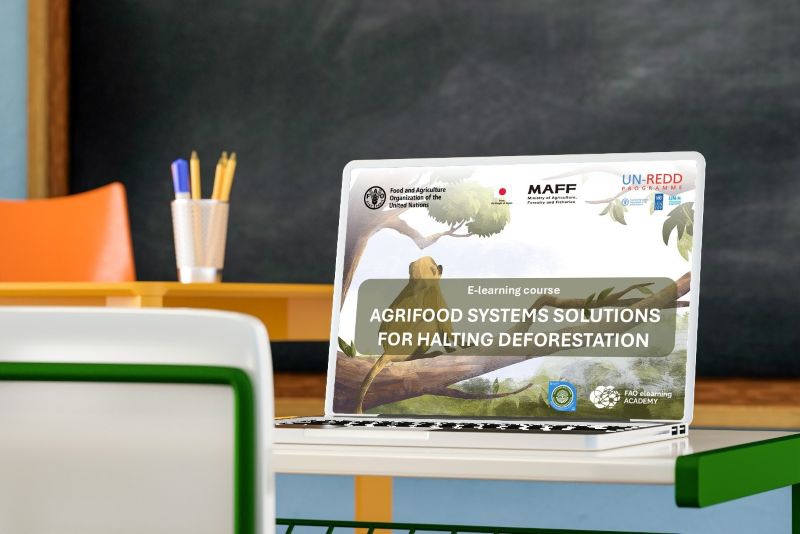
Developed with Japan’s Ministry of Agriculture, Forestry and Fisheries and the UN-REDD Programme, the certified course helps policymakers and practitioners use FAO’s Solutions-tree: solutions to halting deforestation – through sustainable agrifood systems transformation.
Reducing pressure on forests requires more than action within the forestry sector alone. Land-use decisions are shaped by food systems, markets, finance, land tenure, governance, and rural development. This makes halting deforestation a shared policy and development challenge.
To support more coherent responses based on evidence, the Food and Agriculture Organization of the United Nations (FAO) has launched the certified e-learning course Agrifood systems solutions for halting deforestation through the FAO eLearning Academy.
The course is designed to support learners understand the broader context of decoupling agricultural supply chains from deforestation, explore the latest global efforts and key progress, understand how to identify drivers of deforestation, and examine solutions to address them. A key feature of the course is its introduction to the use of FAO’s Solutions-tree: solutions to halting deforestation – through sustainable agrifood systems transformation.
Launched by FAO as part of a broader suite of tools, the Solutions-tree is an online analytical toolkit that helps governments, businesses and communities identify practical, systemic and context-specific solutions to the complex root causes of forest loss.
Rather than offering a single model, the Solutions-tree helps users analyze how different drivers interact in a specific context and how multiple measures can be combined into a more coherent response. It organizes solutions around major systemic shifts, including stronger land governance, more sustainable production models, responsible trade and consumption, better incentives, stronger data and monitoring, and improved rural livelihoods and inclusion.
The new course translates this approach into a practical learning format. It helps users understand why deforestation cannot be addressed through isolated measures alone and why more integrated responses are needed across agrifood systems. It guides learners through the process of identifying drivers, examining trade-offs and synergies, and selecting measures that reflect national and local realities.
The course is organized into three lessons. The first introduces deforestation and forest degradation in agrifood landscapes and explains the importance of forests for food systems, biodiversity and climate goals, and global efforts and progress. The second focuses on how to identify direct and underlying drivers of forest loss and understanding how they interact, including introducing key methodologies and tools to conduct drivers' analysis. The third explores how to identify and prioritize solutions, including using the Solutions-tree toolkit. Together, the lessons provide approximately 1 hour and 50 minutes of learning.
The course is primarily intended for government officials and other stakeholders involved in developing or revising strategies, programmes, and projects related to forests, land use, and sustainable agrifood systems aimed at reducing deforestation. This includes representatives of ministries responsible for agriculture, environment, and forestry, as well as civil society organizations, sustainable agribusinesses, and other private-sector actors.
Learners who complete the course and obtain at least 75 percent in the final assessment receive a digital badge from the FAO eLearning Academy.
It forms part of FAO’s “Halting deforestation” e-learning series, which supports countries in strengthening policy coherence among forests and agricultural sectors, improving coordination and making better use of public action and investment. The series also includes the course Enhancing policy coherence through public expenditure analysis for forests, which complements this new offer by helping users examine how public expenditure can better support forest, climate and biodiversity objectives.
The course was developed with the support of Japan’s Ministry of Agriculture, Forestry and Fisheries and the UN-REDD Programme.
- https://www.un-redd.org/multi-media-stories/working-together-halt-deforestation-why-we-must-focus-systemic-shifts-agrifood
- https://www.fao.org/forestry/newsroom/news-detail/new-fao-tools-to-help-countries-halt-deforestation-through-sustainable-agrifood-systems-transformation/en
- https://openknowledge.fao.org/server/api/core/bitstreams/f9d8803c-6a88-4acd-ac2c-7e2b1e3c75de/content/cd7727en.html
- https://elearning.fao.org/course/view.php?id=1472
Contact: Naoko Takahashi, Forestry Officer