Indigenous Peoples have been guardians, custodians, and stewards of the world’s forests since long before the emergence of the scientific method. Alongside this vital ingredient for sustainable conservation, artificial intelligence (AI) is also now emerging as an increasingly important tool for finding solutions to the climate crisis.
But when AI systems are built without Indigenous data, the solutions offered to frontline communities can reinforce bias, exclusion, disfranchisement, and misrepresentation towards Indigenous Peoples. Therefore, ensuring the involvement in the design of and access to new technologies for Indigenous communities is crucial for unlocking the true potential of AI.
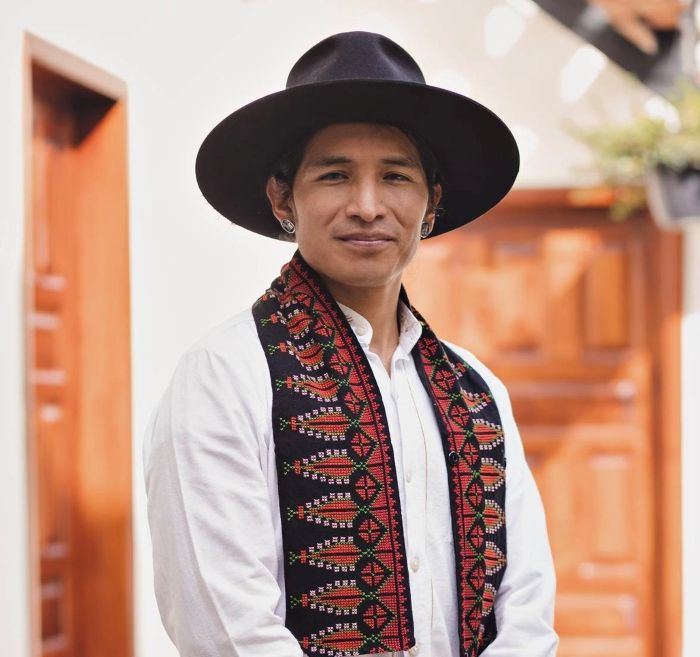
For International Day of the World's Indigenous Peoples on 9 August – which this year has the theme ‘Indigenous Peoples and AI: Defending Rights, Shaping Futures’ – we spoke to WarīN K. Flores, an Indigenous AI expert and Kara and Kichwa Runa in the Andes and Amazon of Chinchay Zuyu, or Ecuador.
With a background in biocultural heritage agroecosystems and land trusteeship, Flores splits his time between Turtle Island, or the United States, and with the Kara and Kichwa Nation in the Andes and Amazon of Chinchay Zuyu, or Ecuador. He is also the founder of the social enterprise Kinray Hub, which looks to catalyze Indigenous R&D governance, digital/data sovereignty frameworks, multicultural healthcare, green economy, heritage agroecosystems (Chakra agroforestry, Indigenous soil health benchmarks), and sustainable forest management initiatives across Latin America, including a REDD+ project in Panama.
Here is what Flores had to say:
Question 1: Why are Indigenous Peoples so vital for forest conservation?
Indigenous Peoples and local communities provide ground truthing for any intervention that is happening on their land. When I work with carbon project developers, biodiversity credit developers, or investors who want to invest in Indigenous communities, I always hear them warn of a lack of return on their investment. There is skepticism that Indigenous Peoples have the capacity to manage finance, or provide Measurement, Reporting, and Verification records to do multispecies riparian buffers.
But members of Indigenous communities provide ground-truth data – meaning, they are living with forests, even if they are deforested, contaminated or pristine. You need someone who is living with forests, someone who values the forest beyond say, the value of a credit or ecosystem service compensations. When I think about projects making the case for forest restoration and conservation, Indigenous Peoples provide that level of custodianship that can make an initiative a reality. Indigenous Peoples are more than rightsholders, they are shareholders of the investment.
Secondly, Indigenous Peoples are the masters and experts. Forget university PhDs, published papers and so forth. Indigenous Peoples, from being a child to an elder, they hear histories, they are in the land planting and caring, year after year. They have an innate insight into the health of forests and agroecosystems, guiding nature-culture evolution.
Thirdly, Indigenous Peoples’ world view is one of nature, culture and humans who are not separate but interconnected - influenced by their environment and engineered by their culture. They belong in agro-ecosystems. When we have security of land, rights and titles, we provide ground truths and can increase development according to our principles and rule of law.
Question 2: How can AI support and empower Indigenous Peoples in their forest conservation efforts?
If we utilize ancestral intelligence and coherently align this to AI’s capabilities, we can inform region-specific needs and priorities (i.e., data for governance on the BioKulture Regionality Systems). This is instead of just using, for example, satellite imagery in AI to predict general droughts, which may not be useful because on the ground, a different reality may be setting precedent. By working carefully with ancestral intelligence to guide the BioKulture Engineering of AI, and Indigenous data sovereignty on data generation/collection, data processing, data application, and data retirement of AI, it can then predict and provide information and recommendations for specific communities in different regions.
AI can write and shape the future. But someone needs to certify and verify AI data on the ground (i.e., data deeds and titles). Indigenous communities have been data generators, data collectors and gatherers, data processors and applicators for millennia – that’s why, at Kinray Hub, we work in Indigenous data curation licensing, the embodiment of Indigenous data sovereignty, AI governance, and fiduciary jurisprudence. Be it science, economy, education or technology – Indigenous Peoples must guide this development in their territories. But these communities are not always part of data processing and designing applications, so these hold biases on how a community might see whether a project is successful or not.
It’s the same with AI – it is often designed by non-Indigenous scientists that have different cultural beliefs leading to contradictions with Indigenous cultural values, rights or laws. The AI outcome could be completely outside the spectrum of what Indigenous Peoples believe to be true. Data is AI’s DNA. I coined the concept of the ‘Central Dogma of AI’ to articulate the sequence of stages through which data passes, from its origin to its eventual retirement, and examine each stage’s implications for Indigenous governance of data, AI systems, and coherent alignment with ancestral intelligence. If that data is corrosive and has been collected by only academic researchers, it has biases. This is a form of data colonization and digital imperialism.
Question 3: How can AI negatively impact Indigenous Peoples?
Let’s say you are a mining company looking to identify potential mining ores that you want to explore. AI can be used, using satellite imagery, to do that - to find specific and potential areas for mining and exploration. Another way we can use AI is to identify biological hotspots in the Amazon or Andes - mostly forests - and create national parks for conservation, or biodiversity-rich areas for bioprospecting (digital sequence information). But this use of AI could result in the removal of Indigenous Peoples from their ancestral lands, acceleration of biopiracy, militarization and weaponization of biodiversity-rich areas, and disfranchisement from the bio/data economy. This is how AI can be negative.
Question 4: How can we overcome these challenges?
There are two forms of experts. One involves people who go to college to get a PhD and to write papers. But we can now apply and study two different systems, to include the second - Indigenous systems and Indigenous big data. We need to create inquiry systems that allow us to study Indigenous systems. Indigenous Peoples are members of communities who are experts on their territory, their knowledge systems, priorities and needs. We want to “combine” the two, and that approach is failing right now.
Also, when we try to bring Indigenous leaders into any negotiations, the language used in these negotiations is often difficult to understand. Even English speakers have a hard time understanding it. Indigenous leaders are often criminalized as “terrorists”, and they do not have financial support for travel to make their contributions. Their counterparts are often part of large NGOs, government agencies, or the private sector with financial backing for pre- and post-negotiation. So, when we say inclusion and participation, we need to think about financial backing for pre- and post-negotiations, legal assistance, and how we bring Indigenous communities to participate and to guide the design of data exchange and AI systems so it can evolve. Indigenous Peoples and local communities must be the centerpiece for making forest restoration, REDD+, conservation, and carbon credits a success.
Question 5: What is the potential of AI for Indigenous Peoples?
There is a strong opportunity for Indigenous Peoples and local communities to issue data curation licenses where their data is collected and processed; as well as retired, under their jurisdiction. This data can then be added to the data economy. The communities can then have direct financing.
The second thing AI can do, is for Indigenous Peoples to gather environmental DNA, satellite imagery, knowledge systems data – and then train Biocultural AI with their own data sets for biodiscoveries. Indigenous youth, elders and women can do biodiscoveries – looking for environmental DNA for potential proteins, fibers and enzymes that will be of significant interest to markets. Biocultural AI can facilitate these biodiscoveries.
We can think about a new era of Indigenous Biotechnology, where communities in Africa or the Amazon, start coming up with enzymes that break down plastics, for example. These things are possible and can reignite the ethical circular bioeconomy. For instance, Kinray Hub’s BioKulture Systems Lab in the Andes, Cloud Forest and Amazonia has launched federated/decentralized science to work with farmers on “digital and genomics our way” literacy, promoting a just transition from big science to the transformation of federated/decentralized science from the ground up.