
Photo credit: Heber Barros/ Amazon Consortium
At London Climate Action Week, more than 95 forest jurisdictions, investors, buyers, and implementers came together to confront a familiar question: if forests are so valuable, why is capital still moving so slowly?
“Every hectare of forest that disappears has a business model behind it,” said Ruth Zugman do Coutto of UNEP, opening the discussion. “And when a hectare stays standing? For decades, the honest answer has been: often, nobody gets paid at all.”
That imbalance, she said, is why carbon markets matter as one of the few mechanisms capable of pricing an asset that markets have long valued at zero. Now the value of forests is no longer in dispute. The bigger question is how to turn that value into investable, credible, and scalable finance.
Demand for high-integrity forest carbon credits is no longer the constraint it once was. Eighty carbon-pricing systems now cover 28% of global emissions, up from roughly 5% two decades ago. Most Paris Agreement Parties have signalled intent to trade under Article 6, and CORSIA is projected to need an estimated 1 to 1.5 GCO2 of credits by 2035. Singapore has already linked its carbon tax to overseas forest credits, and Singapore-based nvestment platform GenZero financing a Ghanaian project selected through the country’s first government tender for nature-based credits.
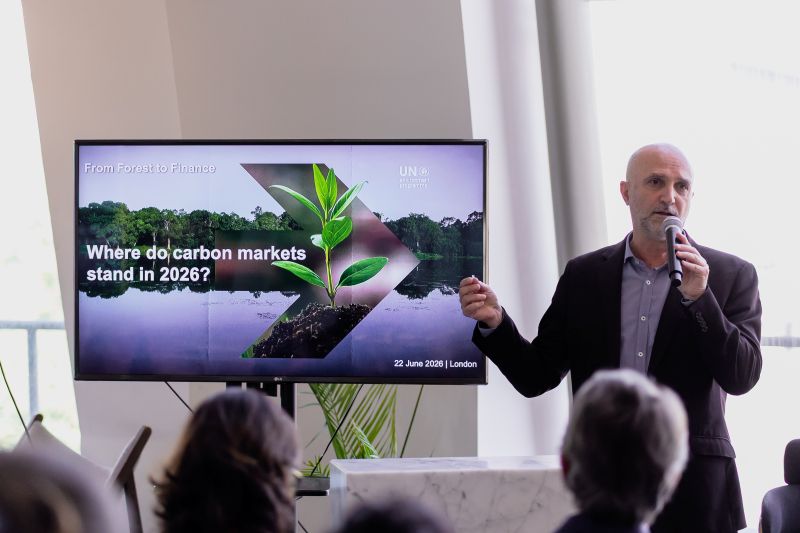
Photo credit: Heber Barros/ Amazon Consortium
“Carbon markets are not a silver bullet, but they are an essential mechanism, and UNEP is committed to getting them right,” said Gabriel Labbate of UNEP.
Execution, however, remains difficult. Ghana has signed bilateral Article 6 deals with sovereign buyers, built a pipeline of roughly 70 projects, and ranks at the top of MSCI’s Article 6 country readiness index. Yet only a handful of projects have reached authorization or issuance.
“Every forest hectare we authorize for export is a hectare we’re choosing not to count toward our own NDC. This shapes how much of this we can actually do,” said Joseph Appiah-Gyapong of Ghana’s Forestry Commission.

Photo credit: Heber Barros/ Amazon Consortium
For investors, the complexity is equally challenging. Puar Si Liang of GenZero pointed to the range of host-country factors that come into play when corresponding adjustments are required, from regulatory considerations such as the clarity of a country’s carbon market policy, to how credits are accounted for in its Biennial Transparency Report.
Across markets, new tools are emerging to help close these gaps and strengthen integrity. Insurance mechanisms, digital trading infrastructure and blended-finance models are helping individual deals move faster, particularly in landscapes where carbon is one revenue stream among several. In East Africa, Farm Africa’s agroforestry work, delivered through Rabobank’s Acorn platform, channels most carbon revenue directly to smallholders through intermediated finance rather than a single offtake model.
“The jurisdictional frameworks aren’t finished, and smallholders can’t wait for them to be. Insetting and supply-chain finance are already doing real work in that gap, often before a carbon methodology is even fully agreed,” said Tom Cadogan of Farm Africa.

Photo credit: Heber Barros/ Amazon Consortium
In Mato Grosso, Richard Smith described territorial finance designed to serve production and conservation together. In Pará, Renata Ribeiro Souza Nobre explained how benefit-sharing with Indigenous Peoples and local communities was built into the core of the deal to strengthen social and environmental integrity.
These mechanisms are helping individual transactions move forward. But they sit on top of a larger problem: finance is still organized in silos, while forests are not.
“Healthy ecosystems regulate climate, sustain food production, secure water resources, conserve biodiversity and strengthen resilience. Yet these interconnected benefits are often financed through fragmented mechanisms,” said André Guimarães, Executive Director of IPAM Amazônia.

Photo credit: Heber Barros/ Amazon Consortium
That fragmentation matters most for the returns hardest to price. Carbon is the benefit forest finance has learned to measure. But UNEP research finds that protecting the world’s most at-risk tropical forests would avoid an estimated USD 81 billion in climate-related damages each year, while also securing pollination services that roughly 10 million people depend on for food.
“Carbon finance opened the door, but carbon was always an incomplete price signal for what forests actually do. We are moving from forests as a carbon commodity to forests as a multi-benefit asset class,” said Mirey Atallah of UNEP.

Photo credit: Heber Barros/ Amazon Consortium
Vanessa Duarte of the Amazon Consortium made the same point from the jurisdiction’s side: “The forest is not only carbon; it is water, food systems, livelihoods and climate stability.”

Photo credit: Heber Barros/ Amazon Consortium
The 22 June event, titled “From Forest to Finance” was organized by UNEP, UN-REDD, the Amazon Consortium and IPAM Amazonia.
Mario Boccucci of UN-REDD Secretariat concluded with the recognition that scaling forest finance now depends less on proving forests’ value, and more on building the conditions that can move capital at scale. This means turning isolated deals into investable pipelines, giving countries the capacity to authorize credits with confidence, reducing investor risk, and ensuring high-integrity transactions and finance reach the jurisdictions and communities.