Introduction
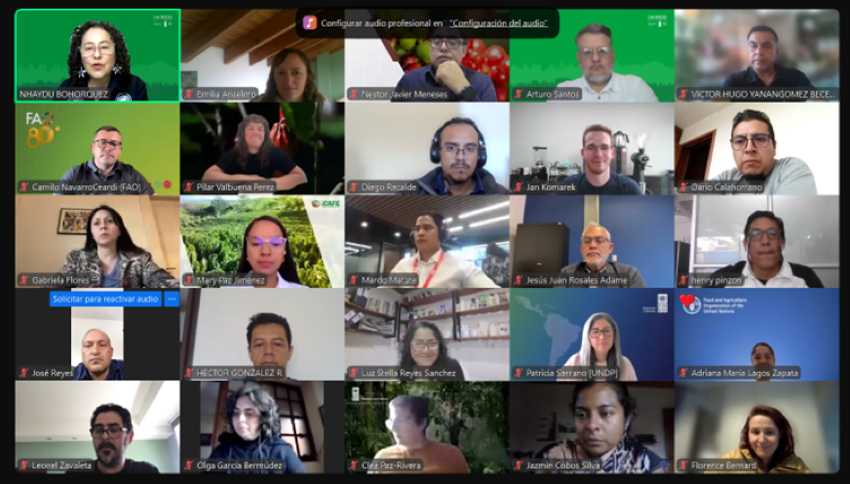
On March 13, 2026, the webinar series “From Farm to Consumer: Articulation for Resilient, Sustainable and Forest-Friendly Agrifood Value Chains” was launched, organized by the UN-REDD Programme, a joint initiative of FAO, UNDP and UNEP. The inaugural session focused on the coffee sector, one of the main drivers of rural development in Latin America and a crop closely linked to the region’s forest landscapes.
The event brought together representatives from governments, producer organizations, cooperatives, companies and international organizations to exchange experiences and reflect on the challenges and opportunities facing the coffee sector in a context of regulatory transformations, increasing demands for traceability and sustainability, and pressures derived from climate change. These dynamics are reshaping how coffee is produced, traded and financed globally.
In Latin America, which accounts for nearly 60% of global coffee production, millions of producers depend directly on this crop for their livelihoods. At the same time, many coffee-growing landscapes are located in areas of high forest value, where agroforestry systems can simultaneously contribute to forest conservation, climate resilience and sustainable rural development.
In this context, the webinar aimed to create a regional dialogue space to explore how to strengthen coordination among producers, cooperatives, governments, companies and the financial sector in order to advance towards more resilient, inclusive and deforestation-free coffee value chains.
Key messages and conclusions
- The coffee sector is undergoing a structural transformation driven by new regulations, increasing traceability requirements and climate change, requiring strengthened resilience across the entire value chain.
- Smallholder producers and their organizations are central to this transition, and their ability to adapt depends on access to technical assistance, financing and markets.
- The transition towards sustainable systems requires strengthening institutional frameworks, traceability systems and information platforms, where data governance plays a key role in ensuring transparency, trust and regulatory compliance.
- Moving towards sustainable value chains involves significant costs that are not evenly distributed, highlighting the need for shared responsibility among public and private actors.
- Advancing resilient, sustainable and deforestation-free coffee value chains requires stronger coordination among producers, cooperatives, companies, governments and the financial sector, as well as spaces for exchange that facilitate learning and regional cooperation.
Event overview
The session began with opening remarks by Nhaydú Bohórquez (FAO/UN-REDD), who moderated the event and highlighted the importance of creating regional dialogue spaces to strengthen coordination among the different actors in the coffee value chain. She emphasized that the current context presents growing challenges for the sector but also opportunities to move towards more sustainable and resilient production models aligned with evolving international market requirements.
Framing presentation
José Arturo Santos (UNDP / UN-REDD Programme) then presented an overview of the coffee sector in Latin America and the main structural changes shaping the global coffee value chain. He noted that the sector faces multiple simultaneous pressures, including new international regulations, increased market demands in terms of quality and traceability, the impacts of climate change, and the need to strengthen financing mechanisms for sustainable production.
He highlighted that Latin America represents the core of global coffee production, accounting for 55–60% of global output, with approximately 11–12 million hectares under cultivation and around 3.5 million producers, many of them smallholders whose livelihoods depend directly on coffee. The sector also generates more than 14 million jobs in the region, making it a key driver of rural economies.
In this regard, it was emphasized that coffee is not only an agricultural commodity but also a complex socio-economic system that supports employment, trade, services and territorial dynamics in rural areas.
The presentation also addressed key structural challenges, including low productivity linked to aging plantations, limited access to long-term financing, price volatility in international markets, and growing demands for traceability and due diligence. Strengthening sector resilience therefore requires greater coordination among producers, cooperatives, governments, companies and the financial sector, as well as investments in innovation, sustainability and monitoring systems.
Country experiences
The event featured national experiences showcasing different approaches to strengthening sustainability, traceability and coordination within the coffee value chain.
From Ecuador, FAPECAFES highlighted the role of smallholder-based organizational models in improving market access, promoting agroforestry systems and advancing traceability. The experience demonstrated that strong producer organization, the reduction of intermediaries and long-term commercial relationships enhance economic sustainability and facilitate adaptation to new requirements such as the EU Deforestation Regulation (EUDR).
Costa Rica, through ICAFE, presented a model based on strong institutional frameworks and sectoral governance, enabling high levels of traceability. Tools such as the CR-CAFÉ platform were highlighted, allowing farm georeferencing, monitoring and compliance with due diligence requirements, along with progress in capacity-building and preparation for deforestation-free coffee exports.
Together, these experiences show that advancing sustainable coffee value chains requires strong producer organization, institutional strengthening, traceability tools and collaboration between public and private actors.
Multi-stakeholder Panel: Coordination and Shared Responsibility Across the Value Chain
The session included a multi-stakeholder panel with representatives from producers, cooperatives, companies and the public sector.
The discussion highlighted that the transition towards sustainable and deforestation-free coffee value chains requires stronger coordination among all actors, from producers to international buyers. Producer organizations and cooperatives play a key role in adopting sustainable practices and strengthening traceability systems.
From the private sector perspective, participants emphasized that increasing regulatory and market requirements make it essential to ensure reliable information on the origin and production conditions of coffee. From the public sector, the importance of governance frameworks, monitoring systems and supportive policies was highlighted to accompany the sector’s transition.
The panel concluded that advancing sustainable and forest-positive coffee value chains requires shared responsibility among all actors, as well as continued dialogue and exchange. It was also noted that sustainability is no longer a value-added attribute, but a minimum requirement for market access.
The webinar series will continue on March 27 with a session on cocoa and on April 17 with a session on livestock.
|
Event Resources The recording of the session and the presentation used during the webinar are available for consultation: |
|
Event in Numbers
|