Introduction
On 17 April 2026, the session “From Farm to Consumer: Let’s Talk About Cattle and Beef” took place, organised by the UN-REDD Programme as part of the regional series on resilient, sustainable, and forest-friendly agri-food supply chains.
This session marked the close of the series, which had previously examined coffee and cocoa supply chains, consolidating a regional dialogue space aimed at analysing the challenges and opportunities for transforming key productive sectors in Latin America.
The session brought together representatives from government, producer organisations, federations, and international bodies, who exchanged experiences and reflections on the challenges and opportunities within the supply chain in the context of structural changes arising from the climate crisis, national regulatory frameworks, and the demands of global markets.
The session focused on the cattle and beef supply chain, a strategic sector for the region both for its contribution to food security and employment generation, and for its weight in national economies and its relevance in international markets. At the same time, livestock farming and beef production lies at the centre of global discussions on climate change, land use, and deforestation, facing increasing demands in relation to sustainability, traceability, and transparency.
In this context, the event aimed to create a regional dialogue space among different actors in the supply chain — producers, sectoral organisations, technical assistance providers, and the public sector — to reflect on how to advance towards livestock models that are more sustainable, resilient, competitive, inclusive, and deforestation-free.
Event proceedings
The session opened with welcome remarks from Felipe Guntín, UNEP Regional Adviser on Forests and Climate, who moderated the session and highlighted the importance of creating regional dialogue spaces to strengthen coordination among the different actors in the cattle and beef supply chain. He noted that the current context presents growing challenges for the sector, but also opportunities to advance towards more sustainable, resilient production models that are aligned with the new demands and structural changes taking place.
Strategic context
Andrés González, FAO Livestock Development Officer, opened the session with a regional overview of the livestock sector in Latin America and the Caribbean, noting that this sector is undergoing a structural transformation driven by the convergence of regulatory, climatic, and market dynamics that are redefining its production conditions and market access. In particular, the growing international emphasis on traceability, sustainability, and the dissociation of production from deforestation processes — reflected in emerging regulatory frameworks and corporate commitments — is raising standards for livestock products from the region.
At the same time, the sector sits at the centre of the global climate debate, owing to its relationship with greenhouse gas emissions, land-use change, and ecosystem degradation. However, this very centrality opens a window of opportunity: livestock farming has the potential to contribute actively to climate change mitigation and adaptation through the adoption of sustainable practices such as silvopastoral systems, regenerative livestock farming, and sustainable productive intensification.
These external pressures overlap with persistent structural challenges in the region, including productivity gaps, limited access to finance, weaknesses in traceability systems, and high vulnerability to climate variability. Added to this is the need to strengthen the inclusion of smallholder producers, who represent a significant proportion of the sector and face greater barriers to adapting to the new demands and changes arising from these pressures.
In this context, the transformation of the livestock sector cannot be addressed in isolation. It requires a systemic approach that brings together the different actors in the supply chain — producers, the public sector, the private sector, finance, and technical assistance — and that promotes the transition towards more efficient, resilient, and sustainable production models. More than a compliance challenge, this represents a strategic opportunity to reposition the region as a global leader in sustainable livestock production.
Country experiences: Evidence from practice
The experiences presented by Mexico and Brazil grounded the strategic context in concrete practices, demonstrating that the transition towards sustainable livestock farming is already under way in the region.
In the case of Mexico, Gilberto Cervantes of 3 Ranchos in Zacatecas presented an integrated production model based on the vertical integration of the supply chain, from input production through to final marketing. This approach incorporates regenerative livestock practices, the use of biological inputs, genetic improvement, and advanced traceability systems, including digital tools that enable the product to be tracked all the way to the consumer. Attention was also drawn to coordination with regional initiatives, such as sustainable livestock platforms, aimed at promoting deforestation-free production.
The experience from Brazil, presented by Luís Fernando Laranja of Grupo Caapora, demonstrated the potential of silvopastoral systems to transform degraded production systems into highly efficient and sustainable models. Through examples such as pasture recovery, tree integration, and improvements in livestock management, it was shown that it is possible to significantly increase productivity without expanding the agricultural frontier. This model not only improves productive indicators but also opens new economic opportunities, such as access to differentiated markets and the generation of carbon credits.
Multi-actor panel: Challenges and enabling conditions
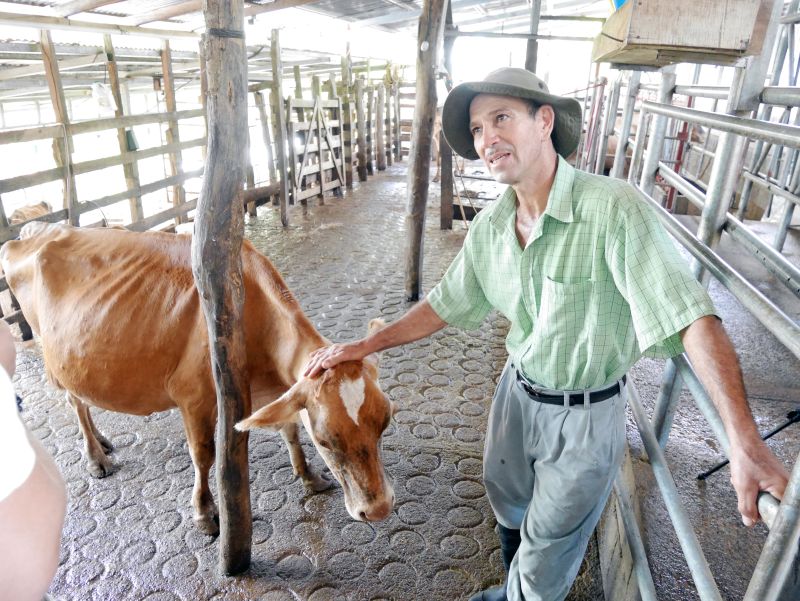
The multi-actor panel, which included Luís Fernando Laranja (Grupo Caaporã, Brazil), José Fabio Chávez (Federation of Livestock Farmers of Guanacaste, Costa Rica), Edwin García (CATIE, Honduras), and Roberto Lopez Irala (Paraguay+Verde Project, Paraguay), explored in greater depth the structural challenges facing the livestock and beef supply chain, as well as the conditions necessary to advance towards an effective transformation of the sector.
From the producers’ perspective, it was noted that the growing demands of markets — particularly in relation to traceability, sustainability, and zero deforestation — are driving a structural change in production methods. Whilst these demands represent an opportunity to capture greater value, they also create significant barriers to entry, especially for producers with more limited access to resources.
In this context, one of the main challenges identified is the transition towards sustainable models, which requires not only willingness but also access to technical assistance, adequate finance, and mechanisms to reduce the risks associated with more sustainable production. The need to align finance with farm plans and capacity-building processes (such as farmer field schools) emerged as a key element in ensuring the effectiveness of investments.
From the perspective of livestock sector associations, the role of collective action, service provision, and facilitating access to technology and finance was emphasised, as was the importance of strengthening coordination across the entire supply chain, including connections with markets that recognise and remunerate sustainability.
From the technical assistance perspective, the importance of comprehensive approaches that combine participatory diagnosis, farm-level planning, and ongoing accompaniment was highlighted, enabling sustainability principles to be translated into concrete changes on the ground.
Finally, from a public policy perspective, challenges were identified relating to inter-institutional coordination, the development of robust traceability systems, and the need to balance productivity objectives with climate commitments. In this regard, progress was noted in instruments such as socio-environmental traceability registers, regulatory frameworks to promote the consolidation of carbon markets, and multi-actor dialogue platforms.
|
Key Messages from the session 1. Sectoral challenges are also opportunities for transformation New regulatory, climatic, and market demands are redefining the livestock supply chain, driving a transition towards more efficient, resilient, and sustainable systems. In this context, sustainable livestock farming is positioned as a key driver of rural development and food security. 2. Livestock farming can be part of the climate solution Experiences from the region show that models such as regenerative livestock farming and silvopastoral systems make it possible to improve productivity whilst restoring ecosystems, sequestering carbon, and reducing pressure on forests. 3. Traceability is a new standard of competitiveness Markets are increasingly demanding information on the origin and conditions of production. Traceability is no longer merely a technical requirement; it has become a key factor for market access and differentiation. 4. The Transition requires finance and technical assistance Advancing towards sustainable models demands investments aligned with technical assistance processes. Tools such as farm plans, farmer field schools, and innovative mechanisms such as carbon credits are key to facilitating this transition. 5. Coordination among actors is an enabling condition The transformation of the sector depends on coordination between producers, the public sector, finance, and markets. Multi-actor spaces are essential for aligning incentives and scaling up sustainable solutions. 6. Inclusion and generational renewal are critical There is a risk of excluding smallholder producers in the face of new demands. At the same time, engaging younger generations through more innovative and sustainable models is key to ensuring the sector’s continuity. 7. Carbon markets represent an emerging opportunity for the sector’s transition The potential of carbon markets was highlighted as a mechanism for recognising and rewarding sustainability efforts in livestock farming, particularly in regenerative and silvopastoral systems. Beyond generating additional income, these instruments can help finance the productive transition, provided they are developed under robust environmental integrity approaches and aligned with territorial realities. |
|
Event resources The session recording and the presentation used during the webinar are available for reference: • Webinar Recording – Livestock Session Passcode: BPv+a2@4 |
|
The event in figures 66 participants 15 countries represented, including Argentina, Bolivia, Brazil, Chile, Colombia, Costa Rica, Ecuador, El Salvador, Guatemala, Honduras, Mexico, Panama, Paraguay, Peru, Dominican Republic 49.8% women 48.9% men 0.9% preferred not to say 0.4% non-binary |
|
For further information, please contact: José Arturo Santos: [email protected] Nhaydu Bohorquez: [email protected] Gabriela Flores: [email protected] Emilia Anselmo: [email protected]
|