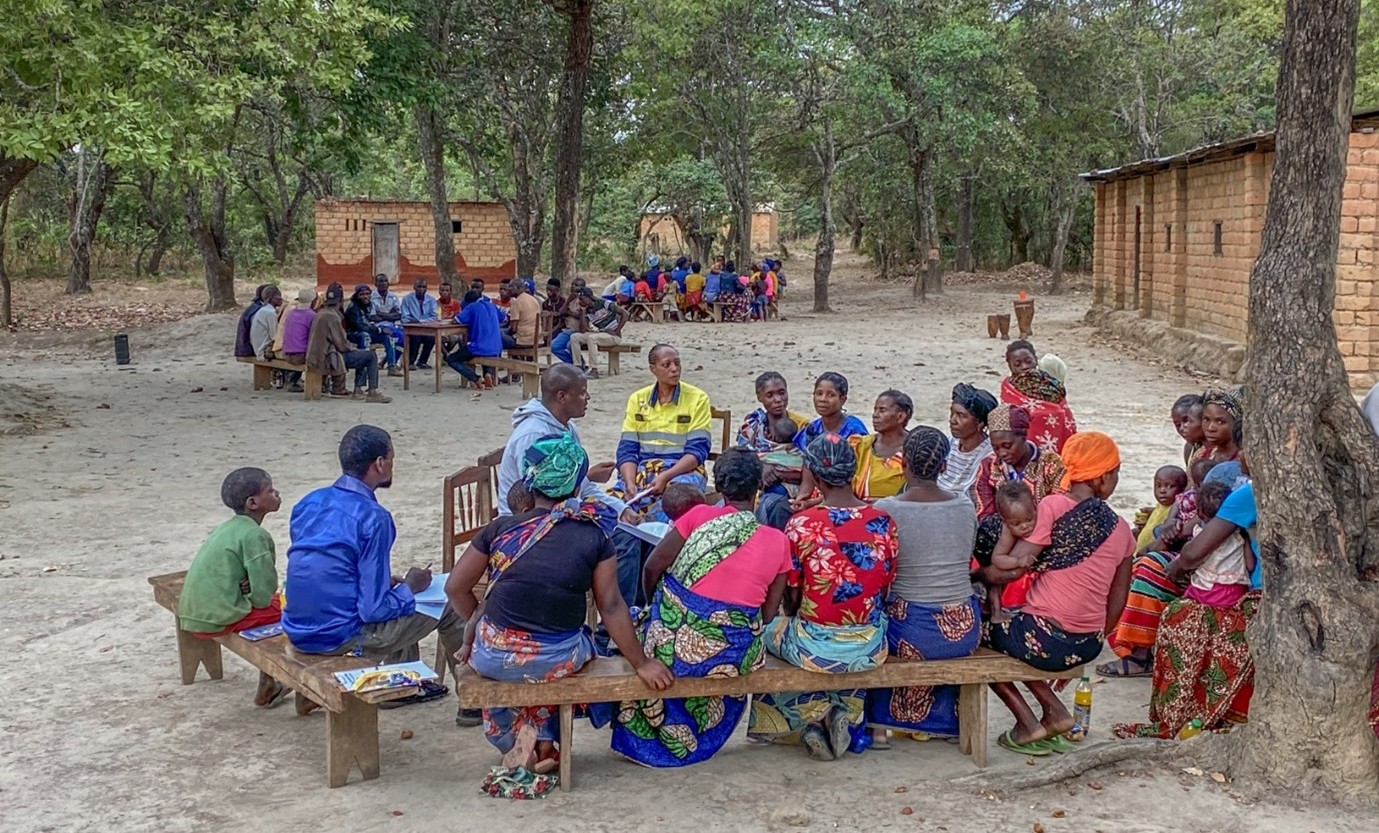
Across Zambia’s expansive forest landscapes, rural communities rely on trees for food, income, and energy. Each year, miombo forests provide significant volumes of wild mushrooms, indigenous fruits, forest honey, wood, and other essentials for daily life, while protecting soil quality and enhancing water security. In rural regions like North Western Province where most people live near forests, livelihoods depend directly on maintaining forest health.
But Zambia’s forests are increasingly under pressure. Unsustainable agriculture, mining, and charcoal production continue to expand, and while forest products from North Western Province could be commercialized to support diversified, sustainable alternative livelihoods, many communities lack access to markets and credit, which would enhance their ability to productively utilize and manage their forest areas.
Through the National Forestry Policy, Community Forest Management Groups (CFMGs) are being established to enable more localized governance and protection of forest resources. Since the community forestry legislation was enacted in 2018, the number of CFMGs has significantly increased, mostly driven by carbon credit opportunities. In North Western Province alone, 127 groups are currently in various stages of formal recognition by the government through the support of the Ministry of Green Economy and Environment’s Forestry Department. This shows that carbon finance, , is not only a potential climate finance opportunity but has already had a positive impact by helping to enforce the Forest Act.
CFMGs are typically established with Zambia’s Forestry Division support – and often alongside conservation organizations or carbon development projects – to establish Community Forest Areas (CFAs) through participatory resource inventories, boundary marking, management planning, and various protection or regeneration measures to curb illegal logging, establish forest-based enterprises such as beekeeping or seedling nurseries. To reach their full potential, however, these groups need better access to tools, resources, and finance.


The challenge: unlocking finance for rural forest groups
Despite the promise of community forestry models in Zambia, CFMGs often struggle to access even basic financial services for them to scale up their activities. Many live far from banks, microfinance organisations, or village-based savings groups. Opening bank accounts requires significant documentation and travel costs that are difficult for rural communities to meet. Affordable commercial loans are nearly impossible for forest communities to access as they are not designed for seasonal forest businesses or complementary small-scale agriculture.
Informal systems exist (small savings groups or village banks where members contribute and borrow money), but these are limited. Loan sizes are small, interest rates high, and connections with formal institutions are weak. Women, who are the primary members of these savings groups, are particularly affected by the lack of suitable financial products and gender-sensitive approaches.
Without affordable finance, communities cannot buy equipment such as beehives or mushroom processing equipment, nor can they scale up the informal forest-based business they typically operate informally. As a result, promising opportunities in honey, wild mushrooms and fruits, artisanal timber, and eco-tourism remain underdeveloped.

The way forward: linking finance, forests, and climate
To help address these challenges, the Food and Agriculture Organization of the United Nations (FAO) under the UN-REDD Programme has been working closely with the Government of Zambia and other partners to support community forestry efforts and local climate action. Analysis on rural finance and related options to enable community and climate actions were then collected in two new publications.
The study, Rural finance assessment in North Western Province, Zambia, mapped financial services operating in five districts – Kalumbila, Mwinilunga, Manyinga, Ikelenge, and Kabompo. While several commercial banks are active in the region, their services are limited and rarely reach rural areas. Long distances, complex documentation requirements for loan applications, and high lending rates exclude most small enterprises. Several microfinance institutions are present in North Western Province, but high rates are also challenging for given margins for small-scale agriculture and forest enterprises.
Informal mechanisms such as savings groups and village banking groups play an important role in rural areas, but they also face constraints: loan sizes are small, interest rates can be high, and links with formal institutions are weak. Women make up the majority of savings-group members, yet still face barriers to larger-scale finance due to social norms and the lack of gender-sensitive financial products.
The assessment concluded that improving financial literacy and building stronger links between informal and formal systems are essential steps to expand financial inclusion and strengthen community-based forestry.
Turning findings into solutions
Building on this analysis, the technical brief , Finance options to enable community forestry and climate action in North Western Province, Zambia, explores how communities can access the capital needed to grow sustainable forest enterprises. It reviews both formal and informal financial systems operating in the province and identifies ways to connect them.
Several practical solutions are put forward:
- Linking community groups with financial institutions, through intermediaries or savings cooperatives, once they demonstrate stable management and repayment records.
- Introducing blended finance mechanisms, where public or donor funds reduce risks for banks lending to small rural producers.
- Adapting financial products to the specific needs of forest-based enterprises, such as allowing movable assets or “timber collateral” as guarantees.
- Strengthening financial literacy so that CFMGs and savings groups can prepare business plans, use mobile banking, and access credit safely.
- Promoting gender-transformative approaches to ensure that women and youth have equal access to training and finance.
- Carbon and ecosystem services finance: support communities to have a fair and informed participation in carbon finance and payments for ecosystem services programmes
The brief also calls for improved coordination among Zambian government ministries and development partners, greater investment in digital and transport infrastructure, and stronger policies to support development of green businesses.


Building a foundation for inclusive climate action
Both publications reflect and share part of Zambia’s broader effort to implement its REDD+ strategy, which seeks to reduce emissions from deforestation and forest degradation while improving and diversifying community livelihoods. Together, they advance national goals for green economic growth, gender equality, and inclusive participation in natural resource management.
As Zambia continues to strengthen community forestry, these tools can help transform forest conservation into a pathway for both environmental resilience and tangible benefits for the people who depend on forests every day.
We invite readers, partners, and practitioners to explore these resources and share them widely.
- Rural finance assessment in North Western Province, Zambia: Covering the districts of Kalumbila, Mwinilunga, Manyinga, Ikelenge, and Kabompo: https://openknowledge.fao.org/handle/20.500.14283/cd7026en
- Finance options to enable community forestry and climate action in North Western Province, Zambia: https://openknowledge.fao.org/handle/20.500.14283/cd6991en