At the 2026 session of the United Nations Permanent Forum on Indigenous Issues (UNPFII), held under the theme “Ensuring Indigenous Peoples’ health, including in the context of conflict,” one message was clear: the health of Indigenous Peoples is inseparable from the health of their lands, territories and ecosystems.
These are not parallel crises, but a single interconnected reality demanding integrated, rights-based solutions.
Throughout the Forum, Indigenous leaders repeatedly emphasized that health, nature, land, spirituality and people are intrinsically linked. Climate change, biodiversity loss, conflict and displacement converge in the same territories and the same futures.
For the UN‑REDD Programme, these conversations reinforced a central principle: effective forest and climate action must be grounded in Indigenous Peoples’ rights, governance systems and knowledge. This requires moving beyond relying on social and environmental safeguards alone and toward enabling Indigenous‑led solutions that strengthen communities and forests ecosystems.
Listening to Indigenous leadership at UNPFII
Indigenous Peoples called for a fundamental shift in how institutions engage with them: not as stakeholders to be consulted, but as rights holders and decision makers. A consistent message emerged: equitable solutions require shared power, stronger Indigenous governance and genuine co‑leadership.
Through dialogues on climate finance, Indigenous‑led bioeconomy, renewable energy and the first Indigenous Women’s Climate Dialogues (IWCD), UNDP, through UN-REDD, helped spotlight Indigenous‑led solutions that are already delivering results, but remain constrained by systems not designed to support them at scale.
The persistent challenge of equitable financing
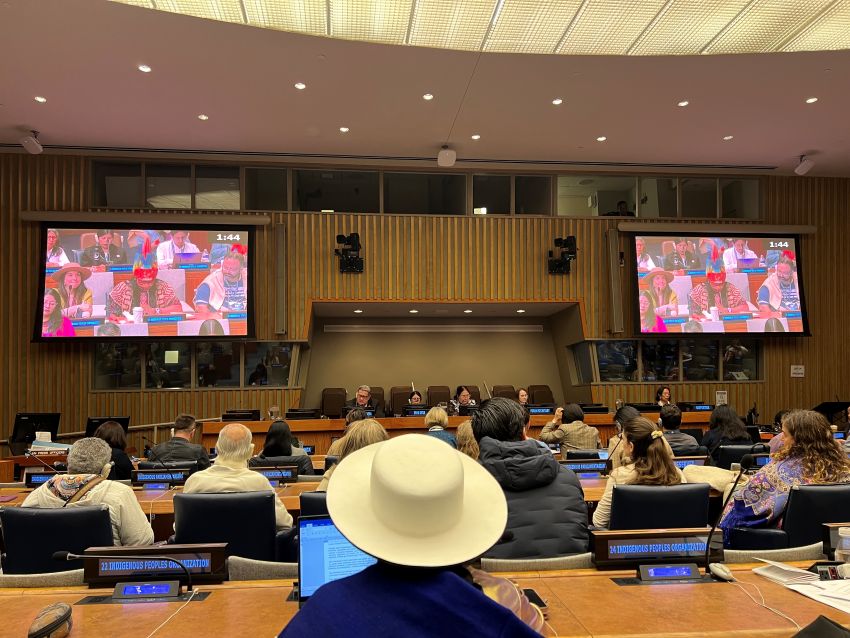
The issue of finance cut across nearly every discussion. In a dialogue on access to climate and development finance, hosted at UNDP, participants emphasized the need for direct access to funding, long‑term and flexible support, and financing models that recognize and strengthen Indigenous governance systems.
During the UNPFII plenary session, UNDP’s statement supported calls for a substantial scale‑up of direct financing to Indigenous Peoples, reinforced by explicit targets, dedicated tracking and accountability mechanisms.
The statement echoed Indigenous Peoples’ calls for dedicated financing modalities within major climate funds, including a direct access pathway under the Green Climate Fund, to ensure that resources are governed in line with Indigenous rights and self‑determination.
UNDP’s Climate Promise and other initiatives such as the Small Grants Programme and the emerging Forest Guardians Bioeconomy Accelerator support Indigenous‑led solutions and expand pathways for direct access to finance, as countries move toward implementing their updated NDCs (“NDC 3.0”).
Beyond consultation: rethinking climate action
Indigenous Peoples are challenging current approaches to “nature‑based solutions” – which they have practiced for generations—but warn that without strong safeguards, the solutions risk being externally-driven and lacking community ownership.
The UN‑REDD Programme reinforces the importance of designing and implementing forest and climate programmes in partnership with Indigenous Peoples; grounded in Free, Prior and Informed Consent (FPIC); and aligned with Indigenous governance systems. In practice, this means aligning climate policies with land and territorial rights, supporting Indigenous institutions, and ensuring that monitoring and accountability systems reflect Indigenous realities.
Women, leadership and the work ahead
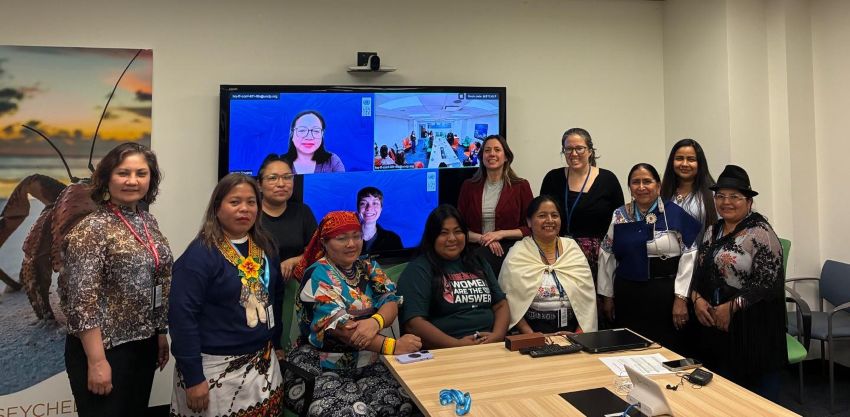
One of the most grounded spaces at UNPFII 2026 was the Indigenous Women’s Climate Dialogues (IWCD). The dialogue provided a platform for Indigenous women to share experiences, align priorities and amplify collective messages around climate and nature. Indigenous women spoke about leadership, the risks they face as defenders of their lands, and the gaps in how global frameworks respond to their realities. A clear message emerged: climate commitments will only be meaningful if they translate into tangible support at the community level. “Leaving no one behind” must be visible in how programmes are designed, how data is collected and how resources are allocated.
Building the bioeconomy together
UNDP’s Forest Guardians Bioeconomy Accelerator fostered dialogue on Indigenous‑led bioeconomies and how Indigenous‑led initiatives can be supported through equitable partnerships and financing. Indigenous peoples emphasized that any bioeconomy model must be rooted in Indigenous cosmologies, spirituality, territorial governance and collective decision‑making, recognizing forests as living systems rather than commodities. Participants underscored the need to avoid extractive and colonial financing approaches, and to build partnerships based on trust, reciprocity and long‑term stewardship.
What stays with us
UNPFII 2026 reaffirmed a fundamental truth: effective climate action is inseparable from rights, and Indigenous Peoples are not at the margins, but at the center of this work. Indigenous‑led climate action, equitable financing and territorial rights are increasingly central to effective climate implementation.
As countries implement NDCs 3.0, ambition must be measured not only by targets, but by how they are achieved and who shapes them. For UN‑REDD, this marks a continuous evolution that aligns with the REDD+ process since it’s design — from ensuring safeguards to enabling Indigenous‑led forest solutions as a central pillar of climate action. It also requires decision-makers, partners, and donors to listen differently throughout programme design and implementation.
Leaving no one behind means more than inclusion. It requires recognizing Indigenous Peoples as essential partners in shaping the future of forests, climate ambition and sustainable development.