Across Southeast Asia, forests cover more than 215 million hectares, forming one of the world’s richest natural assets. More than ecological landscapes, these forests are social and economic systems.
Nearly 200 million people, including women, Indigenous Peoples, and youth, directly or indirectly depend on them for livelihoods, culture, and wellbeing, and over 14 million hectares are already under social forestry schemes across the region. Yet despite this scale and potential, many forest-based community enterprises remain constrained by persistent barriers: limited market access, complex compliance requirements, and insufficient access to finance.
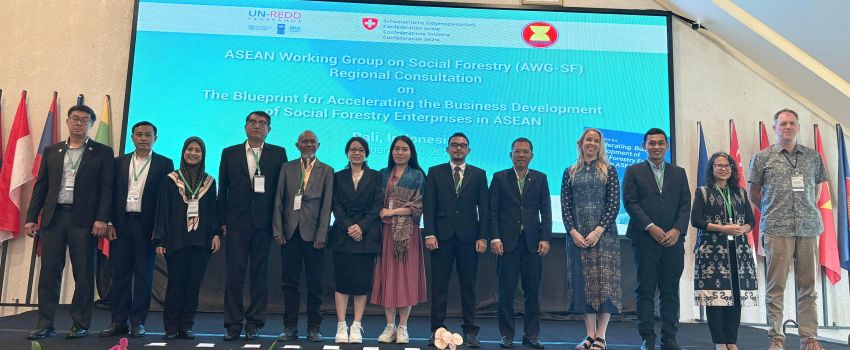
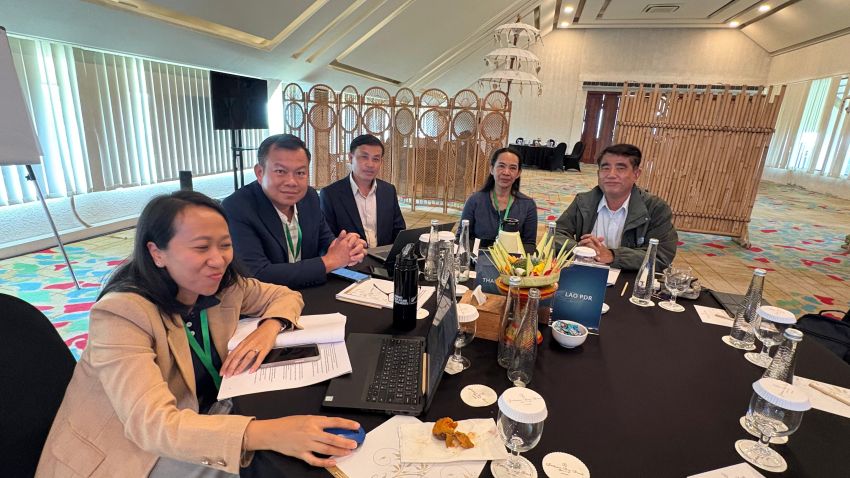
Against this backdrop, members of the ASEAN Working Group on Social Forestry (AWG-SF) recently convened a regional consultation to advance the draft of the ASEAN Blueprint for Accelerating the Business Development of Social Forestry Enterprises (SFEs), a practical regional reference designed to support ASEAN Member States in accelerating SFE business development, value chain upgrading, and access to sustainable markets and investment.
At the center of the consultation was a clear priority: strengthening practical guidance on how SFEs can become:
- commercially viable
- legally compliant and market-connected
- investment-ready
- forest- and nature-positive
Key outcomes from the consultation included consolidated country feedback, peer exchange on national SFE progress and constraints, and agreement on next steps toward finalisation and endorsement through ASEAN processes.
During the consultation, the ASEAN Secretariat emphasized the importance of strengthening sustainable forest management, restoring ecosystems, and expanding nature-based solutions—while grounding these efforts in livelihoods, resilience, and community stewardship.
Dr. Pham Quang Minh, Head of the Food, Agriculture and Forestry Division (FAFD) of the ASEAN Secretariat, underscored the importance of advancing sustainable forest management, promoting nature-based solutions (NbS), and strengthening social forestry development in ASEAN.
He highlighted the ASEAN One Billion Trees Growing Programme as a flagship initiative and welcomed partnerships to support ASEAN Member States in its implementation, reaffirming ASEAN’s commitment to ecosystem restoration, climate resilience, and enhanced climate action in the forestry sector. He further emphasised that sustainable forest management must be underpinned by a strong social dimension, noting that social forestry plays a vital role in improving livelihoods, strengthening climate resilience, and supporting sustainable growth. In this regard, the Blueprint was highlighted as a practical reference to support AMS in strengthening social forestry enterprises, particularly in enhancing business development and market readiness.
The Blueprint itself is being developed following a mandate from the ASEAN Working Group on Forestry (ASOF), with technical support from UNEP, RECOFTC, and NTFP-EP. It is aligned with Member States’ climate and green economy agendas and anchored in ASEAN priorities including ASEAN Blueprint 2025 and the Strategic Plan 2026–30.
Rather than a conceptual framework, the Blueprint is structured as a hands-on playbook. It outlines practical steps to focus on forest products and develop social forestry value chains, introduces criteria to identify SFE clusters, and offers simple methods to make enterprises investment ready. It also presents tested approaches to link SFEs with buyers, ensure compliance, and unlock finance. These are supported by case studies demonstrating practical models and pathways for scaling. Its aim is not to present a ‘silver bullet,’ but to consolidate actionable guidance based on what governments and enterprises need to accelerate real-world enterprise performance.

The urgency is matched by opportunity. ASEAN countries are increasingly prioritizing forests in their climate commitments, with over 80 percent including them directly in national targets. At the same time, SFEs already generate billions across timber and non-timber forest products. Bamboo alone is projected to reach USD 95B by 2030, and ASEAN Member States are well positioned to lead sustainable markets with high-potential forest-based products. With the right enabling environment, SFEs can deliver a triple win—climate action, livelihood opportunities, and inclusive green growth—alongside wider co-benefits including water retention, restored biodiversity, and reversing land degradation.
The consultation is supported by UNEP under the UN-REDD Programme, in collaboration with RECOFTC and NTFP-EP, with funding from the Swiss Government.
Tessa Nerini, Deputy Head, Political, Economic and Cultural Division at the Embassy of Switzerland in Jakarta, reiterated that Switzerland’s long-term engagement is driven by the belief that resilient ecosystems and empowered communities must advance together. She emphasized that forests are central to inclusive green growth in the region, not merely as sites of conservation, but as lived landscapes shaped and safeguarded by the communities who serve as their stewards.
With country feedback consolidated and next steps agreed, the Blueprint is moving toward finalization and endorsement through ASEAN processes, positioning it as a practical regional reference to accelerate social forestry enterprises and strengthen the link between sustainable forest management, investment readiness, and ASEAN’s inclusive green growth agenda.