Virtual session held on 9 April 2026, coordinated by UNEP
Introduction
As part of the 2026 cycle of the Safeguards and Integrity Working Group (SIWG), the 16th session focused on exploring Module 3 of the Learning Journal on REDD+ Safeguards developed by the UN-REDD Programme. The session built on the capacity-building process initiated during previous meetings, moving beyond general concepts towards the practical implementation of safeguards in real-world REDD+ contexts.
The module focused on how to operationalize safeguards throughout the REDD+ lifecycle, introducing key tools and instruments such as Country Approaches to Safeguards (CAS), Safeguards Information Systems (SIS), Summaries of Information on Safeguards (SoI), as well as fundamental aspects related to stakeholder engagement, gender and social inclusion.
Safeguards throughout the REDD+ phases
One of the session's key messages was that safeguards are not a static requirement but rather a continuous process that accompanies the entire REDD+ lifecycle. Rather than being a simple checklist, safeguards represent an evolving approach that develops as countries move from the readiness phase to results-based payments.
During the readiness phase, the emphasis is generally placed on designing instruments and strengthening capacities, including the development of the SIS and environmental and social management frameworks, among other elements. During the pilot phase, safeguards begin to be tested in practice, generating tangible evidence and allowing for adjustments based on implementation experience. Finally, during the results-based payment phase, safeguard systems are expected not only to be operational but also capable of demonstrating clearly and credibly how safeguards are being addressed and respected.
Throughout this process, participants emphasized that one of the greatest challenges lies in moving from conceptual frameworks to practical implementation—that is, translating broad safeguard principles into concrete actions that function effectively in complex, real-world contexts.
Country Approaches to Safeguards (CAS)
The session introduced the concept of the Country Approach to Safeguards (CAS), understood as the set of existing governance arrangements—including policies, legislation, regulations and institutions—that countries use to meet international safeguard requirements while aligning them with national priorities.
It was emphasized that a CAS does not require creating parallel structures. Rather, it seeks to organize, coordinate and strengthen existing systems. In this regard, participants highlighted its value as a tool for reducing institutional fragmentation and avoiding duplication of efforts across multiple safeguard frameworks.
The session also stressed that the national interpretation of safeguards represents a critical step, as it translates global safeguard principles into operational definitions adapted to each country's legal, institutional and cultural context. This process is dynamic and continues to evolve alongside implementation and changing financing requirements.
Safeguards Information Systems (SIS): implementation, evolution and challenges
The SIS was presented as one of the central components of the safeguards architecture. Participants emphasized that it should not be viewed merely as a platform or final product, but rather as an operational system that brings together multiple information sources, institutions and stakeholders.
In this regard, one of the most common misconceptions identified was treating the SIS as something that can simply be "built" and completed, when in reality it requires continuous operation, updating and adaptation. Its value lies not only in reporting information but also in organizing, interpreting and making information useful for decision-making.
The session presented the SIS's core operational functions—data collection, analysis, validation and dissemination—placing particular emphasis on stakeholder validation, not only as a technical exercise but also as a means of building legitimacy and trust in the information generated.
Participants also explored current trends in SIS development, including the transition towards more results-oriented systems, the increasing use of indicators to demonstrate changes on the ground, and the growing need to integrate information from multiple sources, including subnational REDD+ initiatives and voluntary carbon market projects.
Within this context, it was noted that one of today's principal challenges is not only technical but also institutional: ensuring the long-term sustainability of these systems, avoiding information overload, and making certain that they are actively used to support decision-making rather than simply serving reporting purposes.
Summaries of Information on Safeguards (SoI)
The session presented the Summary of Information (SoI) as a key instrument for communicating how safeguards are being implemented. Beyond fulfilling its formal role as a requirement under the UNFCCC, participants emphasized that, in practice, the SoI serves a much broader purpose.
It was highlighted that SoIs have evolved from documents primarily describing legal and institutional frameworks into tools that increasingly seek to demonstrate concrete evidence of implementation. Consequently, the challenge is no longer simply to describe what exists, but to show what is actually happening on the ground.
Participants also emphasized the SoI's dual function. On the one hand, it responds to international reporting requirements; on the other, it serves as a strategic communication tool that enables countries to demonstrate progress, identify gaps, and build credibility with a wide range of stakeholders.
Stakeholder engagement, gender and social inclusion
The session emphasized that safeguard implementation is fundamentally a social process. Stakeholder engagement should therefore not be understood as a one-off requirement, but as a continuous process that spans every stage of REDD+ implementation.
Stakeholder engagement was presented as a continuum ranging from basic information-sharing to more advanced forms of participation, such as co-creation. Participants highlighted that one of the principal challenges is moving beyond formal or purely consultative approaches towards genuinely inclusive processes in which stakeholders can meaningfully influence decision-making.
The session also underscored the importance of integrating gender-responsive and socially inclusive approaches, not only to avoid negative impacts but also to ensure that REDD+ benefits are distributed equitably. This requires, among other things, recognizing structural barriers and designing targeted mechanisms to address them.
The sixteenth session in numbers
|
|
|
|
|
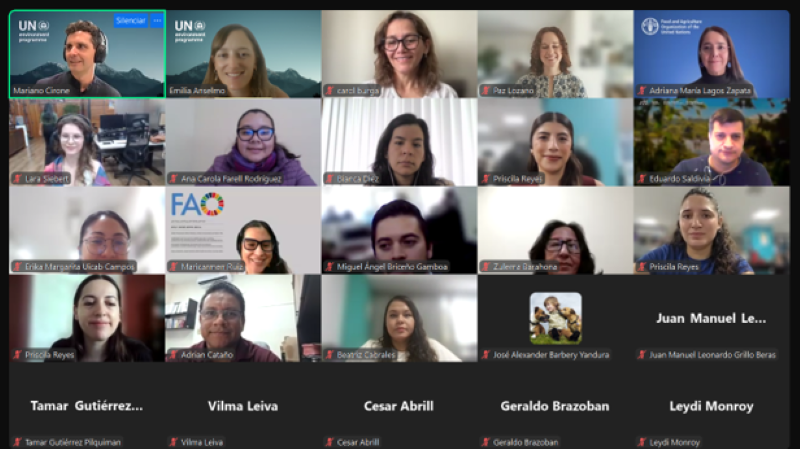
19 participants (71% women, 29% men)
|
8 countries represented: Costa Rica, Mexico, Bolivia, Brazil, Argentina, the Dominican Republic, Colombia and Paraguay
|
90-minute session
|


About the Working Group
The UN-REDD Programme Latin America and the Caribbean Safeguards and Integrity Working Group brings together practitioners and experts working on the design, implementation and monitoring of REDD+ safeguards across the region. Its objective is to facilitate the exchange of experiences, good practices, common challenges and lessons learned in order to strengthen safeguard implementation, monitoring and reporting, while enhancing the environmental and social integrity of REDD+ across Latin America and the Caribbean.
For more information about the Working Group, please contact the UNEP team through Mariano Cirone at [email protected].