Virtual session held on 30 April 2026, coordinated by UNEP
A session to conclude the UN-REDD Programme Learning Journal on REDD+ Safeguards series
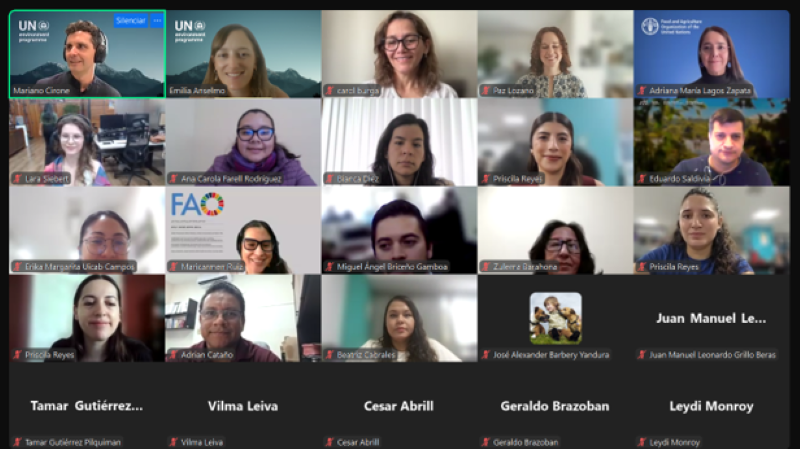
 On 30 April, the 17th session of the Safeguards and Integrity Working Group (SIWG) was held, focusing on the practical application of safeguards through Module 4 of the Learning Journal on REDD+ Safeguards, the most advanced module of the series. The session was delivered by the UNEP Safeguards Team for the UN-REDD Programme, consisting of Julieta Lahud, Emilia Anselmo and Mariano Cirone.
The Learning Journal on REDD+ Safeguards forms part of the revitalized REDD+ Academy and serves as a practical learning resource designed to strengthen the understanding and application of safeguards in REDD+ implementation. This updated edition incorporates a decade of technical assistance provided by the UN-REDD Programme to countries across Latin America and the Caribbean, Africa, and Asia-Pacific, translating safeguard concepts into practical guidance, tools, case studies and lessons learned to support the design, implementation, monitoring and reporting of safeguards.
The Learning Journal is available at: https://reddacademy.in.howspace.com/learning-journal-redd-plus-safeguards.
From theory to practice: integrating safeguards into complex REDD+ systems
One of the session's central themes was the introduction of the concept of Integrated Safeguards Systems (Figure 1), understood as an architecture that coherently integrates different components and tools to ensure that safeguards are addressed and respected throughout REDD+ implementation.
These integrated approaches respond to the reality that REDD+ is increasingly implemented across multiple scales—including projects, subnational jurisdictions and national programmes—and under a variety of financing mechanisms, including jurisdictional carbon markets, results-based payments and other funding sources.

Figure 1. Source: United Nations Environment Programme (2025). REDD+ Academy Learning Journal: REDD+ Safeguards.
Among the core components typically included in an Integrated Safeguards System are:
- Safeguards Information Systems (SIS)
- Benefit-sharing systems
- Grievance redress mechanisms
- Environmental and social risk management tools
By design, these approaches are flexible and can be adapted to the specific needs and level of REDD+ maturity of each country or jurisdiction.
As a practical mechanism for implementing an Integrated Safeguards System, countries and jurisdictions may develop Cross-cutting Safeguards Frameworks. These consist of establishing a jurisdiction- or institution-specific safeguards framework that builds capacities, tools and institutional arrangements capable of simultaneously meeting the safeguard requirements of multiple applicable frameworks in a more efficient and coherent manner.
Developing such a framework first requires mapping and aligning the different safeguard frameworks that apply—for example, the UNFCCC Cancun Safeguards, the Green Climate Fund safeguards, and the World Bank Environmental and Social Framework. Based on this alignment exercise, countries can identify the safeguard themes or standards—such as biodiversity, Indigenous Peoples, gender or sustainability—that will form the basis of their own cross-cutting safeguards framework. Examples from Argentina, Paraguay and Chile were presented during the session (Figure 2).

Figure 2. Source: United Nations Environment Programme (2025). REDD+ Academy Learning Journal: REDD+ Safeguards.
Other key components of an Integrated Safeguards System
The session also explored several additional elements that are commonly considered essential components of Integrated Safeguards Systems for REDD+, including:
- Environmental and social risk management tools, which help identify, assess and manage potential environmental and social risks throughout REDD+ implementation.
- Benefit-sharing systems and arrangements, one of the most complex aspects of implementing REDD+ on the ground, ensuring that benefits are distributed in a fair, transparent and equitable manner.
- REDD+ grievance redress mechanisms (GRMs), presented as a fundamental governance tool for channeling concerns, resolving disputes and strengthening accountability. Although GRMs are not explicitly included within the Cancun Safeguards, they can be understood as an enabling mechanism for achieving several of them, particularly those related to transparent and effective forest governance and access to justice (Safeguard B), the rights of Indigenous Peoples, local communities and other stakeholders, and the full and effective participation of relevant stakeholders (Safeguard D).
- Systems and methodologies for measuring and reporting non-carbon benefits, enabling countries to demonstrate REDD+'s broader contribution to sustainable development by highlighting positive outcomes for people, ecosystems and governance alongside climate change mitigation.
While the region already offers promising examples of measuring, monitoring and reporting non-carbon benefits—including experiences from Chile and Costa Rica—the session also highlighted the need to continue developing methodologies and indicators that strengthen the links between Measurement, Reporting and Verification (MRV) systems and Safeguards Information Systems (SIS).
Final reflections
The session concluded with a clear message: safeguards are evolving from a compliance-oriented approach towards becoming a central pillar of the integrity, legitimacy and effectiveness of REDD+. In this context, safeguards are no longer viewed as a collection of independent requirements but rather as an integrated management system that supports the design, implementation, monitoring and continuous improvement of REDD+ actions, helping to strengthen trust among stakeholders and enhance the credibility of achieved results.
The session in numbers
|
|
|
|
|
22 participants (71% women, 29% men)
|
8 countries represented: Costa Rica, Mexico, Bolivia, Brazil, Argentina, the Dominican Republic, Colombia and Paraguay |
90-minute session
|


About the Working Group
The UN-REDD Programme Latin America and the Caribbean Safeguards and Integrity Working Group brings together practitioners and experts working on the design, implementation and monitoring of REDD+ safeguards across the region. Its objective is to facilitate the exchange of experiences, good practices, common challenges and lessons learned in order to strengthen safeguard implementation, monitoring and reporting, while enhancing the environmental and social integrity of REDD+ across Latin America and the Caribbean.
For more information about the Working Group, please contact the UNEP team through Mariano Cirone at [email protected].