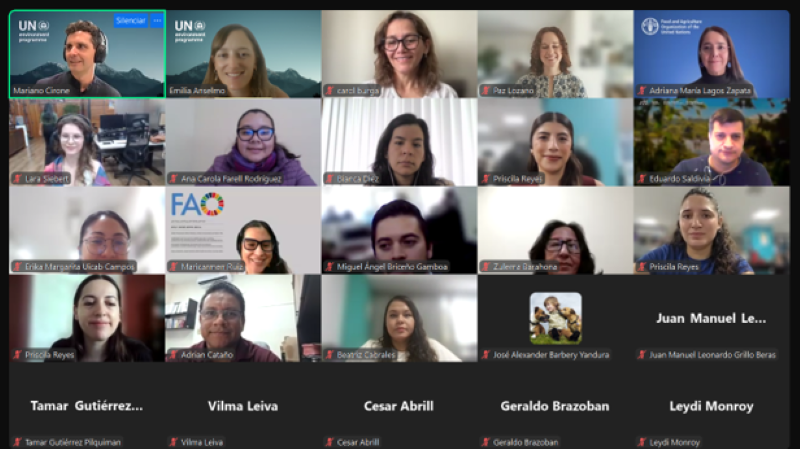
Session held virtually on 19 March 2026, coordinated by UNEP
Introduction
On 19 March 2026, the 15th Session of the Safeguards and Integrity Working Group (GTS) of the UN-REDD Programme in Latin America and the Caribbean was held. This regional platform aims to promote knowledge exchange and strengthen capacities on REDD+ safeguards.
The session had two main objectives: to present the new REDD+ Safeguards Learning Journal and to provide an introductory training on the fundamental concepts of safeguards.
This meeting marked the beginning of a new cycle of work aimed at strengthening technical capacities and fostering a shared understanding of safeguards, in a context where their proper implementation is key to ensuring the integrity, inclusiveness, and sustainability of REDD+ actions.
The REDD+ Safeguards Learning Journal: a tool for implementation

The REDD+ Safeguards Learning Journal is a practical tool developed by the UN-REDD Programme to support countries in the implementation of safeguards. It is structured in four modules and combines conceptual explanations, country examples, case studies, and tools to facilitate its application in national and subnational processes.
During the session, the Howspace platform was also presented, where users can access interactive resources and microlearning materials linked to the Journal.
Fundamental concepts of safeguards in REDD+
The second part of the session focused on an introductory training aimed at establishing a common understanding of safeguards in the REDD+ context. Safeguards were defined as a set of principles, policies, and measures designed to manage environmental and social risks associated with land-use interventions, highlighting their dual objective: to prevent negative impacts and to promote benefits beyond carbon.
In this context, the evolution of safeguards was discussed, moving from a “do no harm” approach to a more comprehensive “do good” approach. This implies not only mitigating risks but also actively promoting benefits such as biodiversity conservation, strengthened forest governance, and improved livelihoods.
The session also explored the potential risks and benefits of REDD+, both social and environmental, emphasizing that all interventions involve risks and that the key challenge lies in anticipating and managing them effectively from the design stage.
Finally, the Cancun Safeguards were introduced as the international reference framework under the UNFCCC, along with the three associated requirements —including the Safeguards Information System (SIS) and the Safeguards Information Summaries (SIS/SoI)— and their link to the four pillars of REDD+, which are necessary to access results-based finance.
Current challenges: multiple safeguards frameworks
The session also addressed one of the main challenges currently faced by countries in implementing REDD+: the coexistence of multiple safeguards frameworks linked to different sources of finance and international standards. In practice, this means that countries must simultaneously respond to the requirements of the UNFCCC, multilateral funds such as the Green Climate Fund and the World Bank, and carbon market standards such as ART’s TREES and Verra’s Verified Carbon Standard (VCS), each with its own approaches, levels of detail, and operational requirements.
This diversity creates technical and institutional complexities, including overlapping requirements, differences in interpretation, and an increasing administrative and financial burden associated with reporting, verification, and compliance processes. In this context, the importance of advancing towards more integrated safeguards approaches was highlighted, enabling countries to harmonize these frameworks and strengthen national safeguards systems, reducing duplication and improving efficiency.
As a strategic approach for contexts with multiple safeguards requirements, the Learning Journal introduces the concept of Integrated Safeguards Systems, understood as flexible arrangements that allow the articulation of different safeguards instruments —such as the SIS, grievance redress mechanisms, benefit-sharing systems, and environmental and social risk management tools— to apply, monitor, and report safeguards more coherently across different REDD+ levels and sources of finance.

This approach not only supports compliance with multiple requirements but also positions safeguards as a central component for accessing climate finance and ensuring credible and sustainable results.
Closing
The 15th session marked the beginning of a new phase of the GTS focused on strengthening capacities and supporting countries in the practical implementation of safeguards. In this context, the Learning Journal is positioned as a key tool to move from conceptual understanding to operational application in real-world settings.
Future sessions will focus particularly on how to implement and integrate safeguards in practice, especially through Modules 3 and 4, with the aim of further strengthening REDD+ safeguards implementation in the region.
Session highlights
|
|
|
|
|
50 participants (63% women, 35% men, 2% preferred not to respond)
|
10 countries represented
|
120-minute session
|


About the Working Group
The Safeguards and Integrity Working Group of the UN-REDD Programme in Latin America and the Caribbean brings together professionals and experts involved in the design, implementation, and monitoring of REDD+ safeguards. Its objective is to share experiences, good practices, common challenges, and lessons learned, in order to strengthen safeguards implementation, monitoring, and reporting, and to enhance the environmental and social integrity of REDD+ in the region.