About the session
The twentieth session of the Safeguards and Integrity Working Group (GTS) launched a new dialogue series aimed at identifying opportunities, risks and enabling conditions for linking safeguards information generated by forest initiatives in the voluntary carbon market with national Safeguards Information Systems (SIS).
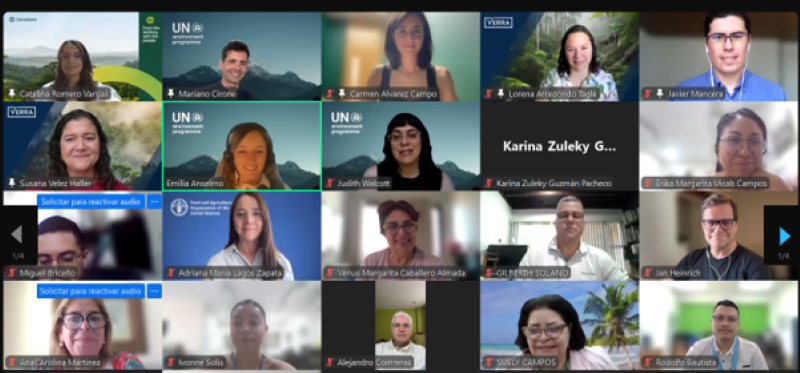
The session was opened by Judith Walcott, UNEP Nature-based Solutions and Markets Coordinator for Latin America and the Caribbean, and moderated by Emilia Anselmo and Mariano Cirone, safeguards and forests specialists from UNEP’s UN-REDD Programme team. The session featured a high-level panel representing different private-sector perspectives, with representatives from Verra (Susana Vélez Haller and Lorena Arredondo Tagle), Cercarbono (Catalina Romero), Wildlife Works (Javier Mancera) and Sylvera (Carmen Álvarez).
During the session, participants exchanged experiences on safeguard approaches applied to forest projects in the voluntary carbon market (hereinafter “forest projects”), key challenges to their effective implementation, and emerging regulatory trends in Latin America and the Caribbean. The discussion promoted joint reflection on opportunities to strengthen the articulation between private project-level safeguard approaches—particularly those associated with methodologies related to the conservation and sustainable use of native forests (REDD), afforestation, reforestation and revegetation (ARR), improved forest management (IFM), and other related methodologies—and national SIS.
Note: This document summarizes the interventions made during the session. The messages presented reflect the views of the panelists and do not constitute normative recommendations or an institutional position of the UN-REDD Programme or the participating institutions.
Main topics addressed
The carbon crediting programs represented in the session, Verra and Cercarbono, presented the safeguard-related provisions of their standards. Both highlighted the evolution of standards towards more comprehensive approaches based on risk management, continuous improvement, and the incorporation of mechanisms to strengthen community participation, transparency, benefit-sharing, and grievance redress systems. They also presented the mechanisms through which they seek to promote and verify the application of the social and environmental provisions of their standards throughout the life cycle of initiatives.
The rating agency Sylvera presented the role of independent assessments in the voluntary carbon market. Carmen Álvarez noted that, under the organization’s approach, environmental and social performance can influence how initiatives are assessed by buyers and investors.
Wildlife Works, representing forest carbon project developers and implementers, highlighted the importance of complementing standard requirements with its own approach centered on Indigenous Peoples, local communities and other communities. It emphasized that effective safeguard implementation requires building long-term relationships of trust and recognizing and strengthening existing capacities and governance systems in each territory.
The second part of the session focused on opportunities for incorporating voluntary carbon markets (VCMs) into national safeguard approaches. Mariano Cirone presented an overview of emerging experiences in the region. The presentation highlighted recent experiences in Brazil, Colombia and Peru related to the regulation and reporting of safeguards at the initiative level and their potential articulation with national SIS. It was noted that this trend could contribute to strengthening the environmental and social integrity of projects, while also potentially increasing transaction costs and even affecting the viability of some initiatives if regulatory mechanisms are not designed in a proportionate manner.
During the final dialogue, panelists agreed on the importance of deepening engagement between governments and carbon crediting programs to explore interoperability options that ould redue duplication and reporting burdens, in accordance with each country’s priorities, public policies and institutional decisions.
Some key messages from the session
- Panelists noted that attention to risks, rights, and social and environmental impacts should be maintained throughout the entire life cycle of forest initiatives in the voluntary carbon market.
- The importance of ensuring the effective participation of Indigenous Peoples, local communities and other communities was highlighted, including recognizing their capacities and governance systems and ensuring accessible grievance redress mechanisms.
- Panelists agreed on the importance of deepening dialogue between governments and carbon crediting programs to explore interoperability options that reduce duplication and reporting burdens, in accordance with each country’s priorities, public policies and institutional decisions.
Resources
The session recording and presentation are available on the HowSpace platform of the UN-REDD Programme Safeguards and Integrity Working Group for Latin America and the Caribbean.
Access to the platform requires a one-time registration, which can be completed through the following link:
🔗 HowSpace - Grupo de Trabajo de Salvaguardas e Integridad
The session in numbers
|
|
|
|
|
101 participants (54 % women, 45 % men, 1 % preferred not to disclose) |
14 countries represented (Argentina, Bolivia, Brazil, Chile, Colombia, Costa Rica, Dominican Republic, El Salvador, Guatemala, Honduras, Mexico, Panama, Peru and Uruguay) |
120-minute session
|


About the Working Group
The UN-REDD Programme Safeguards and Integrity Working Group for Latin America and the Caribbean brings together practitioners and experts working on the design, implementation and monitoring of REDD+ safeguards across the region. It provides a space to exchange experiences, good practices, common challenges and lessons learned, with the aim of improving safeguard implementation, monitoring and reporting and strengthening the environmental and social integrity of REDD+ in Latin America and the Caribbean.
For further information on the Working Group, please contact the UNEP team through Mariano Cirone at [email protected] and/or Emilia Anselmo at [email protected].