Introduction
On 24 September 2025, the Safeguards and Integrity Working Group (GTS) for Latin America and the Caribbean (LAC) of the UN-REDD Programme held its 11th session virtually, bringing together more than eighty participants. The session focused on subnational safeguard systems for REDD+ and their perspectives for effective implementation, with attendees that included representatives from subnational governments and experts in forest and climate policy.
In opening remarks, Judith Walcott, Regional Coordinator of the Climate Change Mitigation Unit of the UN Environment Programme (UNEP) for LAC, emphasized that the GTS has consolidated itself as a true regional community of practice with more than three years of activity, and capable of generating learning and replicable models. The session brought together safeguard specialists to support countries at different levels of action and under various financing frameworks, ranging from results-based payment programmes to public funds and carbon markets.
Walcott also highlighted how Session 11 was a milestone as it focused, for the first time, on the subnational level - recognizing its increasingly prominent role in REDD+ implementation. Walcott thanked the active participation and commitment of the members, stressing that this collective process is key to ensuring that subnational actions respect rights, promote inclusion, and generate lasting environmental benefits.
Conceptual framework: Challenges and opportunities of subnational approaches
Mariano Cirone, safeguards focal point at UNEP, gave a presentation on the conceptual framework for understanding how subnational approaches fit within the system defined by the United Nations Framework Convention on Climate Change (UNFCCC).
A central aspect of the presentation was the clarification that the safeguard requirements of the Cancun Agreements (COP 16) are of a national nature, as Parties to the UNFCCC are national governments. However, a current trend is the development of jurisdictional REDD+ carbon market programmes at the subnational level, especially in federal countries with large territorial extensions - such as Mexico, Brazil and Argentina - which responds to both the need for territorial action and the opportunities for additional forest and climate financing.
The challenge of multiple compliance
In terms of safeguards, subnational REDD+ programmes face a dual challenge: aligning with the national safeguards approach, and also complying with the additional requirements of international carbon standards, such as ART-TREES or VCS-JNR. This creates costly and complex situations for safeguards reporting and implementation, where dozens of indicators from different sources must be met simultaneously: international standards, national obligations, and occasionally, bilateral or multilateral donors.
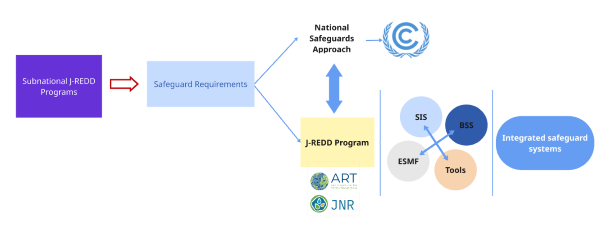
To organize these demands, Cirone shared information on "Integrated Safeguard Systems" approaches (Figure 1). Although not a formal concept under the UNFCCC, in practice it can involve coherently articulating different components and systems related to REDD+ safeguards within a given jurisdiction (national or subnational), such as the Safeguard Information System (SIS); benefit-sharing mechanisms; environmental and social management frameworks; grievance redress mechanisms; gender plans; participation protocols and free, prior and informed consent (FPIC), among others.
The safeguards cycle
Cirone introduced and reflected on the concept of the "safeguards cycle" to illustrate the typical four phases involved in the practical application of safeguards (Figure 2). It begins with the “Approach” (1), primarily through the legal and institutional framework; followed by the “Implementation” phase (2), which is carried out through various instruments such as gender and consultation plans, benefit-sharing mechanisms, among others; then comes “Monitoring and Evaluation” (3); and finally, the “Reporting” phase (4), through the SIS, Safeguards Summary of Information, or other related tools. It is important to note that each jurisdiction may decide which instruments to develop and how to integrate them to address these four phases when implementing REDD+ safeguards, based on their specific context, resources, and capacities.
Cirone warned about the growing interaction between public and private actors in carbon markets, where private, plot-level projects and jurisdictional programmes are converging. This trend is forcing subnational governments to strengthen their systems to ensure the environmental and social integrity of REDD+ across its various scales and financing and implementation modalities.


Subnational experiences: Jalisco, Mato Grosso and Misiones
A panel moderated by Felipe Guntin (UNEP) and Milena Terra (UNDP) presented the implementation experiences of three pioneering jurisdictions in the region.
Jalisco, Mexico: consolidating a state-level strategy
Marta Cabrales Delgadillo, Director of Biological Corridors and Watersheds at the Secretariat of Environment and Territorial Development of Jalisco, and Orión Flores, Safeguards Consultant for the REDD+ Jalisco, Pronatura Sur and Mexico Climate Initiative, presented the experiences of Jalisco, a state with over a decade of work in REDD+. Jalisco finalized its State REDD+ Strategy in 2022 after an extensive public consultation process and made progress in developing a state safeguards plan and key instruments such as MRV and emission reference levels.
Jalisco has promoted complementary initiatives such as certified sustainable agave and deforestation-free beef production, reinforcing coherence between sectoral policies and REDD+ objectives. The state is currently in the early implementation phase and expects to register its LEAF proposal under ART-TREES soon.
Key challenges include consolidating the benefit-sharing plan through a more robust participatory process and strengthening technical capacities to meet international standard requirements.
Mato Grosso, Brazil: Harmonizing indicators
Caroline Chichorro, Environmental Analyst at the Secretariat of Environment of Mato Grosso, Brazil, presented the case of Mato Grosso, which is considered a regional pioneer due to its territorial scale and key role in the conservation of the Amazon and Cerrado biomes. The state began its REDD+ journey in 2013 with the creation of the State REDD+ System and has been implementing the REDD+ Early Movers (REM) Programme since 2017, funded through results-based payments with German and British support.
The programme is grounded in the Cancun Safeguards principles but adapted to multiple requirements: the World Bank’s standards, indicators from the National REDD+ Commission (CONAREDD+) at the national level, and more recently, considering registration under the ART-TREES standard. This mosaic of demands poses a major challenge for the Safeguards Team at the Mato Grosso Environment Secretariat (SEMA), particularly due to the difficulty of managing parallel monitoring systems.
Chichorro emphasized that financing and capacity-building are the two main challenges, especially at the subnational level, as safeguard teams often learn through practice and tend to rely heavily on external consultants.
Misiones, Argentina: Integrated programme
Pamela Krushelnytsky, Director of Carbon Market and Sustainable Climate Finance Mechanisms, Misiones, Argentina, and Silvia Korth, Forestry Engineer and MSc in Forest Sciences and certified in Data Science applied to Natural Systems, explained that Misiones is in the final stage of registering its “REDD+ ECO2” programme - a jurisdictional REDD+ programme under the Verra VCS-JNR standard, covering the entire provincial territory and allowing for the nesting of private projects (Option 2).
The strategy aims to maintain at least 50 per cent forest cover, reduce illegal deforestation by 10 per cent annually, and strengthen the system of protected areas and early warning mechanisms. Key milestones include the update of the native forest land-use plan (2017), creation of the Climate Change Secretariat (2020), and signing of agreements for the first carbon credit transaction (2023).
The main challenges include ensuring the financial sustainability of the programme, consolidating environmental and social management plans, and guaranteeing cultural appropriateness in the application of safeguards.
Open dialogue: Emerging issues
During the exchange, several key issues emerged, such as the dynamic nature of Environmental and Social Management Plans (ESMPs) and the need for these plans to be adapted and updated over time. A representative from Misiones said that monitoring indicators must be adjusted as new activities are implemented and additional risks identified.
A representative from Colombia’s Ministry of Environment raised the issue of reporting responsibilities in community-led initiatives (REDD+ projects designed, managed, or led directly by local communities or Indigenous Peoples), and queried how safeguards should be interpreted when the implementers are also the rights-holders.
The discussion also addressed the dilemma between complexity and proportionality. Some participants warned that high transaction costs can outweigh the benefits of results-based payments, while others emphasized that simplification should not come at the expense of robustness - especially regarding the rights of Indigenous Peoples and local communities.
Finally, the review process for subnational REDD+ programmes was discussed, which, under both TREES and JNR, is carried out by Validation and Verification Bodies (VVBs). Some participants expressed concern that auditors with experience primarily in small-scale private projects might apply that same lens when evaluating subnational public policies, failing to consider the scale and territorial complexity involved.
Conclusions and next steps
UNEP’s Walcott concluded the session by highlighting how safeguard approaches capable of responding to diverse realities, international standards, and national legal frameworks will become increasingly important. The cases presented demonstrated both the innovation capacities of subnational governments and the challenges of financing, indicator harmonization, institutional strengthening, and cultural appropriateness.
Another key challenge identified was ensuring coherence across governance levels, so that national and subnational systems complement each other rather than duplicate efforts. All three experiences underscored the importance of creating dynamic, adaptive, and culturally appropriate safeguard systems - capable of meeting integrity requirements without compromising effectiveness or territorial legitimacy.
Session 11 in numbers:
|
|
|
|
|
89 participants |
9 countries represented |
120-minute session |


Sobre el Grupo de trabajo
El Grupo de Trabajo de Salvaguardas e Integridad del Programa ONU-REDD en América Latina y El Caribe es un espacio conformado por personal y expertos/as que trabajan en el diseño, implementación y monitoreo de salvaguardas REDD+ en la región, con el objetivo de compartir experiencias, buenas prácticas, desafíos comunes y lecciones aprendidas, en aras de mejorar la implementación, monitoreo y reporte de salvaguardas y fortalecer la integridad ambiental y social de REDD+ en ALC.
Para obtener más información sobre el trabajo, por favor contacte al equipo de PNUMA a través de Mariano Cirone en: [email protected]